
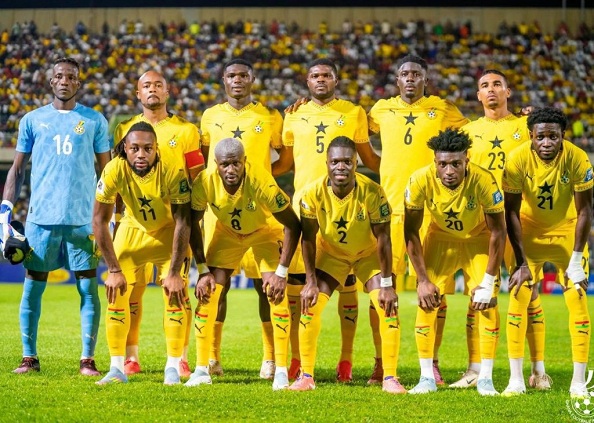


Ghana's Black Stars will know their opponents for the 2026 World Cup when the draw is held today, December 5, in Washington D.C.
The ceremony, which takes place at the Kennedy Center, will begin at 5 pm GMT and marks the first major milestone in the final build-up to a World Cup that will span Canada, the United States, and Mexico between June 11 and July 18, 2026.
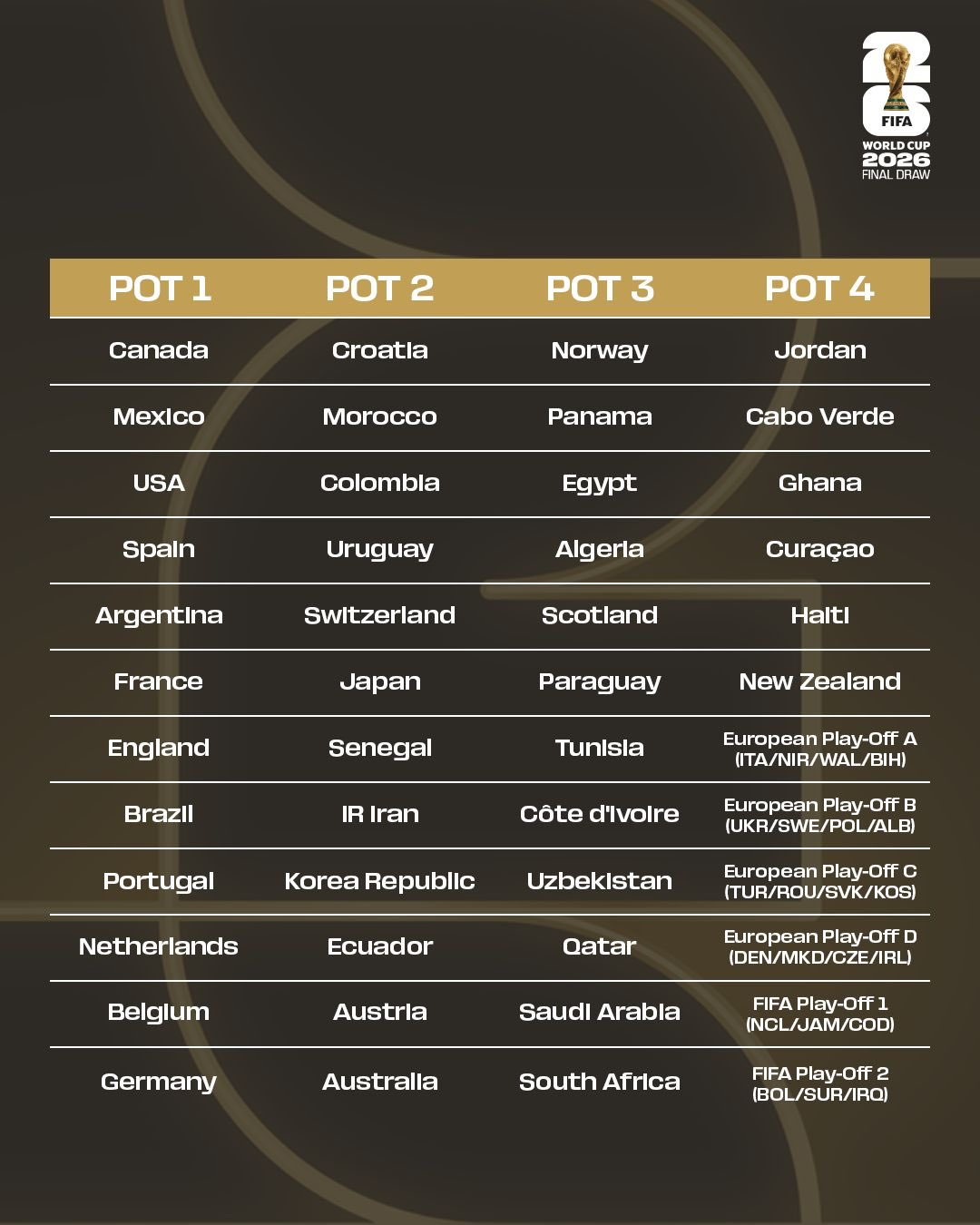
Ghana has been placed in Pot 4 with Jordan, Cabo Verde, Curaçao, Haiti, New Zealand, the four UEFA play-off winners, and the two FIFA Play-Off Tournament qualifiers.
Under the draw rules, Ghana is likely to face a top-seeded Pot 1 team such as Spain, Argentina, or England, along with a Pot 2 side like Croatia, Japan, or familiar rivals Uruguay. Regulations also ensure that no group will feature more than one African team.
The Black Stars qualified for the World Cup by topping Group I with 25 points, finishing ahead of Mali, Madagascar, Chad, the Central African Republic, and Comoros.
After a group stage exit in the previous World Cup, the Black Stars will be aiming for a deeper run in the tournament.
How has FIFA seeded the draw?
The 48 teams have been placed into four pots of 12 based primarily on FIFA World rankings.
The exceptions are the three hosts who are automatically in pot one, and the teams who will qualify through the six play-off paths, who go into pot four.
Given some of the teams involved in the four European play-off paths, they have the potential to create some strong groups.
Italy and Denmark would have been in pot two because of their world rankings had they qualified directly, while Wales would have been in pot three.
The six play-off paths are:
UEFA Play-off A: Italy, Wales, Bosnia-Herzegovina, Northern Ireland
Uefa Play-off B: Ukraine, Poland, Albania, Sweden
UEFA Play-off C: Turkey, Slovakia, Kosovo, Romania
UEFA Play-off D: Denmark, Czech Republic, Republic of Ireland, North Macedonia
Fifa Play-off 1: DR Congo, Jamaica, New Caledonia
Fifa Play-off 2: Iraq, Bolivia, Suriname
How will the draw work?
The 12 groups will include one team from each of the four pots.
Fifa will start by drawing the teams from pot one.
Co-hosts Mexico (A1), Canada (B1) and the United States (D1) will have coloured balls with their flags on to denote their special status. Their group positions are pre-determined to make sure they play all their games in their own countries.
The draw will then continue with pots two, three and four in order.
What is this about the top four teams being kept apart?
Fifa's big idea is to set up the best chance of blockbuster ties in the latter stages of the World Cup.
So for the first time it is giving special seeding status to the top four in the world rankings - Spain, Argentina, France and England.
Crucially, this status will only apply if the countries win their groups.
Let's take a look at how it will work, using England as our example.
Each of the four countries will be drawn into a group in a different coloured quadrant of the bracket, as shown in the image below.
Spain (ranked 1) and Argentina (2) must be in opposite halves and cannot meet until the final, likewise France (3) and England (4).
France and England would not be able to meet either Spain or Argentina until the semi-finals.
Let's say that France come out first and go into Group C, placing them into the green quadrant on the right side of the draw. That means England can only go into the blue or turquoise quadrants on the left side, groups E, F, G, H or I.
If Argentina then drop into the blue quadrant, that further restricts England only to turquoise - groups G or H.
Are the four seeds being given an easy ride? Not necessarily.
Each quadrant has a potential last-16 tie between two group winners. For instance, the blue quadrant has a meeting of the winners of Group E and Group I. That means a seeded team could meet another pot one side, let's say perhaps Brazil.
Being drawn into groups C, F, H or J looks potentially more favourable, as it is not possible to play another group winner until the quarter-finals.
If one of the four seeded teams finishes as group runners-up, then they lose the ranking privilege.
So if England were to finish second in Group H, they would move out of turquoise and into red - perhaps meeting Spain, Argentina or France as the winners of Group J in the first knockout round.

If Spain, Argentina, France and England win their groups they will slot into separate quadrants for the knockout bracket
What are the draw restrictions to watch out for?
There can be no more than one team from the same confederation per group. So, for instance, Brazil and Uruguay (Conmebol) cannot be in the same group, nor can Panama and the United States (Concacaf).
There is an exception for Uefa because there are 16 teams and only 12 groups. That means four groups will contain two European nations.
It all seems relatively straightforward, but as we go on these constraints are going to cause some serious complications as countries skip groups to avoid clashes with teams from their own confederation.
That means it will not just be case of teams slotting into Group A, and then Group B, and then Group C in order as they are drawn.
When we get to pots three and four, it might seem like countries are being sent to random groups.
Fifa needs to prevent something called deadlocking, which happens when it is no longer possible to complete the draw while following the regulations.
The major issue comes from the teams who can potentially qualify via the inter-confederation play-off pathways and will go into pot four.
Pathway 1 has New Caledonia (OFC), Jamaica (Concacaf) and DR Congo (CAF)
Pathway 2 has Bolivia (Conmebol), Suriname (Concacaf) and Iraq (AFC)
Both pathways have a Concacaf team, so they are automatically blocked out of four groups (those containing the United States, Mexico, Canada and Panama).
The first pathway is less of problem, because the only other Oceania team, New Zealand, are also in pot four.
But the second pathway makes it complicated, because there are 17 deadlocking nations in pots one, two and three. So, the only way to complete the draw is for the team that qualifies via this route to go into a group with two European countries and an African nation.