
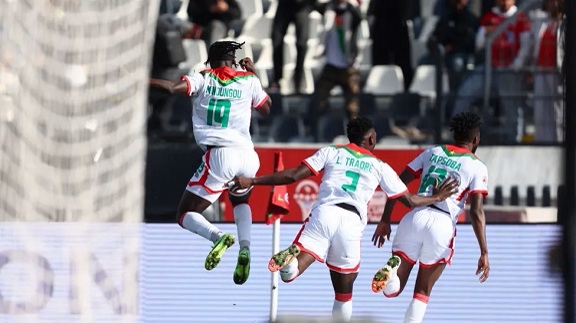


Two goals deep into injury time gave Burkina Faso a stunning comeback win over 10-man Equatorial Guinea in Group E at the 2025 Africa Cup of Nations.
Edmond Tapsoba scored the decisive goal in the final seconds of the match in Casablanca, heading home a rebound to complete an extraordinary turnaround.
The game was goalless at the break but the contest shifted five minutes after half-time when the video assistant referee (VAR) intervened to upgrade Basilio Ndong's yellow card to a straight red for a studs-up challenge on Bertrand Traore.
But the 10 men remarkably went ahead in the 85th minute when unmarked substitute Marvin Anieboh planted a superb header into the top corner.
Burkina Faso poured forward as eight minutes of stoppage time were signalled and were rewarded as Georgi Minoungou latched on to a precise pass and calmly fired low into the corner to level.
Equatorial Guinea barely had time to regroup before Tapsoba landed the decisive blow after reacting quickest following a scramble in the six-yard box.
Burkina Faso will travel to Rabat on Sunday for their second group fixture against Algeria, while Equatorial Guinea remain in Casablanca for a clash against Sudan.
Both these sides reached the last 16 at the 2023 finals in Ivory Coast, and it is the West Africans who have taken a big step towards reaching the knockout stage again.
Sunderland forward Traore was in the thick of the action as Ndong was sent off, while Brentford's Dango Ouattara endured a frustrating afternoon for the Stallions.
The winger was one of the main drivers of attacking momentum for his side, repeatedly forcing goalkeeper Jesus Owono into action.
He thought he had set up an opener for Lassina Traore with less than 20 minutes remaining, but the striker's effort was eventually ruled out for offside.
Equatorial Guinea striker Emilio Nsue, who was the top scorer at the last Afcon with five goals, remained on the bench throughout and coach Juan Micha will need to patch up his side before what could prove to be a crucial match with the Sudanese.
BBC