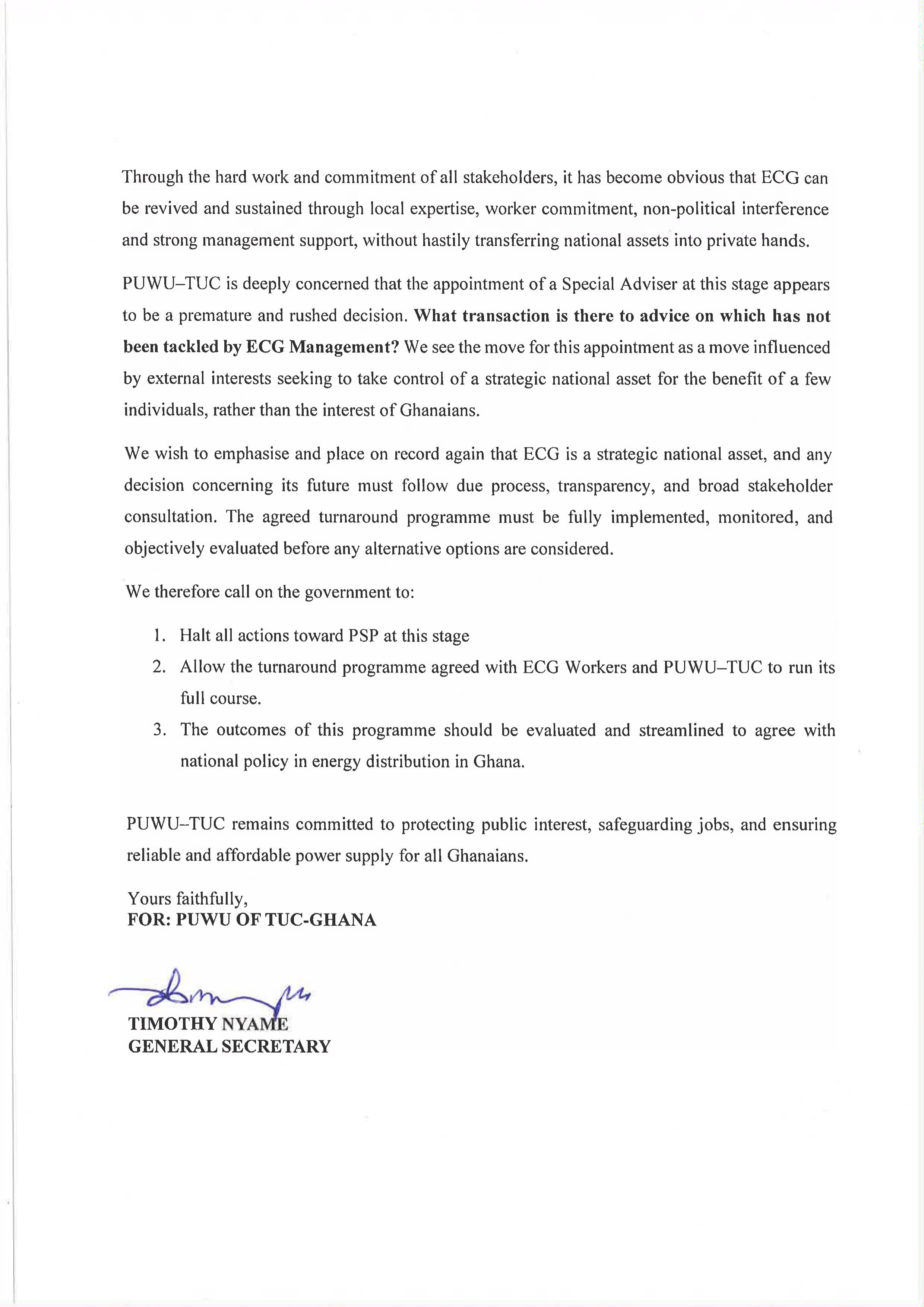



The Public Utility Workers’ Union of the Trades Union Congress (PUWU-TUC), Ghana, has strongly opposed what it describes as a rushed government move toward private sector participation (PSP) in the Electricity Company of Ghana (ECG).
In a statement, the union said it was taken aback by media reports suggesting that government plans to appoint a transaction adviser to oversee ECG’s transition into private sector participation before the Christmas break.
According to PUWU-TUC, the move contradicts an ongoing turnaround programme agreed upon with the Ministry of Energy and currently being implemented jointly by ECG management and workers.
The union explained that the turnaround programme resulted from extensive engagements with the Minister for Energy and Green Transition and was designed to revive ECG through internal reforms rather than privatization. It noted that clear deliverables and timelines were agreed as part of the roadmap and are already being executed, making the proposed appointment of a transaction adviser premature.
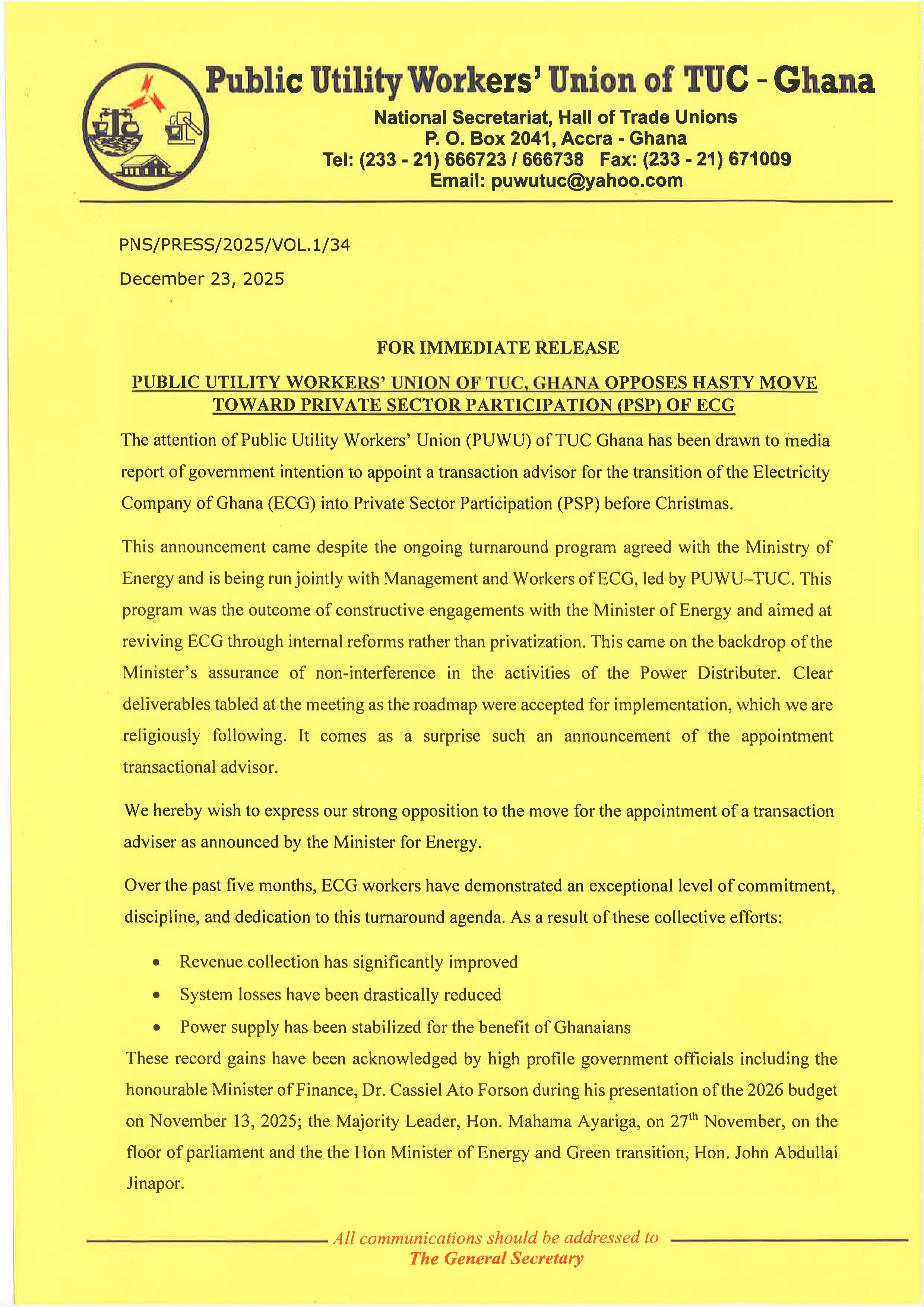
PUWU-TUC pointed to notable gains achieved over the past five months, including improved revenue mobilization, reduced system losses, and a more stable power supply.
These improvements, the union said, have been acknowledged by senior government officials, including the Minister for Finance, Dr. Cassiel Ato Forson, the Majority Leader in Parliament, Mahama Ayariga, and the Minister for Energy and Green Transition, John Abdullai Jinapor.
The union expressed concern that introducing a special or transaction adviser at this stage could open the door to external interests seeking control of a strategic national asset. It stressed that ECG can be revived and sustained through local expertise, worker commitment, effective management support, and minimal political interference.
PUWU-TUC therefore called on government to suspend all moves toward private sector participation, allow the agreed turnaround programme to run its full course, and subject its outcomes to an objective assessment in line with Ghana’s national energy distribution policy.
The union reaffirmed its commitment to protecting the public interest, safeguarding jobs, and ensuring reliable and affordable electricity supply for Ghanaians.