
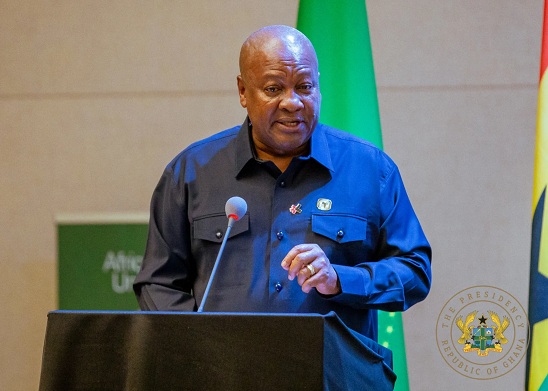


President John Dramani Mahama has called on African leaders to intensify efforts toward achieving gender equality, stressing that empowering women is essential for the continent’s economic transformation and sustainable development.
Speaking at a high-level breakfast meeting on financing and reaffirming Africa’s gender commitments, held on the sidelines of the 39th Ordinary Session of the African Union (AU) Summit in Addis Ababa, President Mahama described gender parity as a collective responsibility rather than an issue affecting women alone.
“And let me thank you for the honor done me in decorating me with this pin. I’ll wear it with pride, and I think it will be a symbol that the effort to create gender parity is not only a female issue, it is for both male and female,” he said.
Mahama emphasized that Africa’s development ambitions cannot be realized without fully integrating women into economic and governance structures.
“We need not merely to reaffirm commitments, but to confront a central truth that gender equality is not peripheral to Africa’s development. It is fundamental to our economic transformation, our social resilience and sustainable growth,” he stated.
The Ghanaian leader warned that gender-focused programs across the continent continue to suffer from inadequate funding, particularly during periods of economic austerity.
“Let us be candid, despite decades of declarations, Africa’s gender agenda remains chronically underfunded. Gender responsive programs are often the first casualties when we decide to implement austerity,” he said.
Mahama further highlighted the economic benefits of investing in women, arguing that gender equality is not only a moral obligation but also a strategic development priority.
“The evidence is unequivocal. Gender equality makes economic sense. Investments in women raise productivity, strengthen resilience and expand economic growth. Every woman entrepreneur creates jobs, every girl educated multiplies prosperity, and every barrier removed unleashes innovation,” he noted.
He urged African countries that have yet to ratify key continental gender frameworks, including the Maputo Protocol, to do so without delay. Mahama also called for swift ratification and implementation of the African Union Convention on Ending Violence Against Women and Girls.
“Violence against women and girls is not only a moral outrage, it is an economic catastrophe, costing Africa billions annually in healthcare, lost productivity and justice expenditures,” he said.
Highlighting Ghana’s progress, Mahama pointed to significant milestones including improved female representation in governance and initiatives to promote girls’ education. He expressed optimism about women’s political leadership in Ghana.
“I am confident that sooner rather than later, a woman will occupy the highest office of president in Ghana,” he said.
The president also announced major financial commitments by Ghana to promote women’s economic empowerment, including funding for the Women’s Development Bank.
“In our 2026 budget, we allocated 401 million Ghana cedis… targeted at expanding affordable credit, financial literacy and enterprise support for women, particularly those in the informal and vulnerable employment,” he revealed.
Mahama acknowledged emerging educational challenges affecting boys while celebrating improvements in girls’ education.
“We’ve attained gender parity in school enrollment and improved completion rates for girls. Indeed, we need to come out with a boy child program to keep the boys in school,” he said.
Calling for renewed continental commitment, Mahama proposed five key pillars to drive gender equality, including political leadership, resource mobilization, policy coherence, accountability, and strengthened partnerships.
He also issued four major calls to action for African Union member states, including adopting gender-responsive budgeting by 2028 and accelerating women’s financial and economic inclusion.
“The reality before us is simple. Africa cannot afford to leave more than half of its population behind, not if we are serious about building the Africa we want,” Mahama stressed.
He concluded by urging governments, private sector partners, and civil society organizations to align resources and actions toward measurable progress.
“The true test of this meeting will not be the speeches we’ve given here today, but tomorrow’s budgets, the laws and protection for women and girls. When we meet again, let it be to announce results and not to explain delays,” he said.