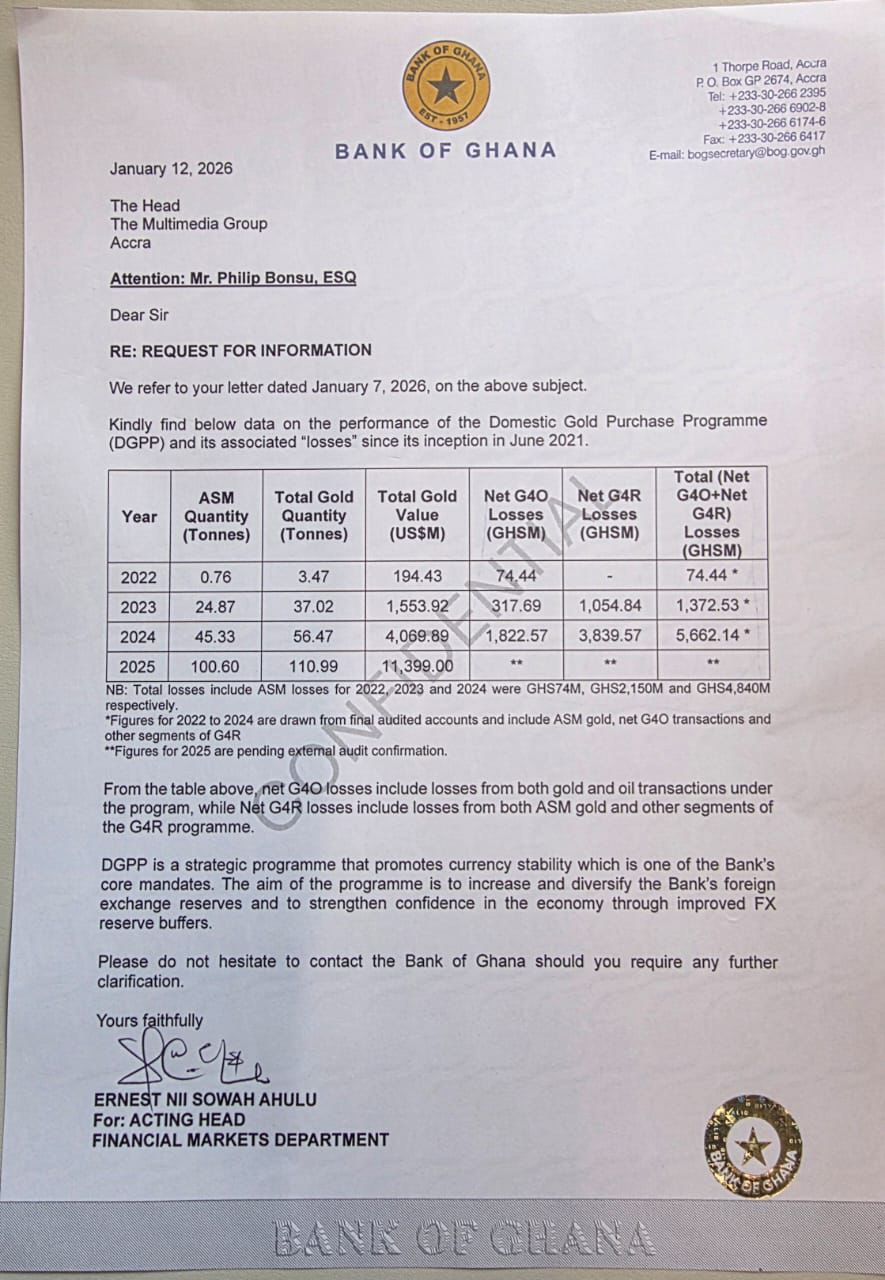



The Bank of Ghana (BoG) has disclosed a significant rise in losses under its Domestic Gold Purchase Programme (DGPP), with figures hitting GHS 5.66 billion in 2024.
Launched in June 2021, the DGPP is designed to bolster the stability of Ghana’s currency by managing domestic gold supplies.
Data obtained by Asempa FM’s Philip Osei Bonsu through a Right-to-Information (RTI) request revealed that net losses surged from GHS 74 million in 2022 to GHS 1.37 billion in 2023, before ballooning in the following year.
The increases are attributed to net G40 losses, covering gold and oil transactions, and net G4R losses, which include artisanal and small-scale mining (ASM) gold operations and other segments.
“The DGPP is a strategic programme that promotes currency stability, which is one of the Bank’s reserve buffers,” the BoG stated. The institution emphasised that despite the rising losses, the programme continues to be a key stabilising tool for the national economy.
Preliminary figures for 2025 indicate that the Bank purchased 100.6 tonnes of ASM gold, bringing the total gold purchased to 110.99 tonnes, valued at $11.4 billion. These numbers, however, are subject to external audit verification.
Analysts have noted that while the DGPP contributes to reserve accumulation, the escalating losses highlight the complexities of managing large-scale gold operations alongside other financial instruments. The Bank has invited further queries for additional clarification.
The RTI request, submitted by Ekosiisen, cited Article 21(f) of the 1992 Constitution and the Right to Information Act, 2019 (Act 989), demanding a detailed account of the programme’s status.
The petition highlighted that while the BoG’s 2024 Annual Report did not reference these losses, there remains no official comprehensive report detailing the profits or losses of the G4R initiative since its inception.
Specifically, the request seeks:
-
Annual Purchase Volumes: Total gold acquired each year under the G4R programme.
-
Financial Value: The monetary value of gold purchased annually since the programme began.
-
Profit/Loss Statements: Year-by-year statements of all recorded profits or losses.