
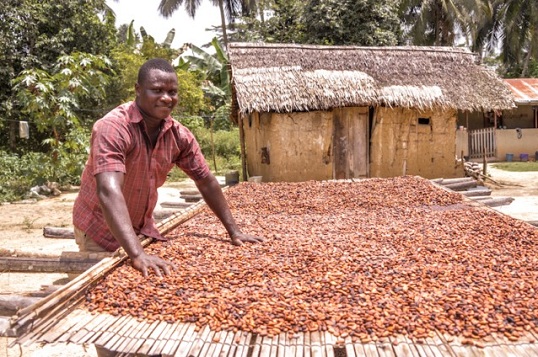


The government has disbursed GH¢855 million to offset outstanding payments owed to cocoa farmers.
This follows months of delays that left many producers uncompensated after supplying their beans to licensed buying companies.
The intervention, authorities say, is part of a broader effort to calm tensions within the cocoa value chain, restore trust among farmers and buying firms, and stabilise the operations of the Ghana Cocoa Board (COCOBOD).
Beyond settling arrears, the government has unveiled a sweeping reform agenda targeting the financial and operational structure of the cocoa sector. Central to the measures is a reduction of more than GH¢1,000 in the producer price per bag — a decision that has generated strong reactions across farming communities and industry stakeholders.
At a press briefing held on Thursday, February 19, 2026, Chairman of the Finance Committee, Isaac Adongo, described the steps as unavoidable if the sector is to be rescued from deepening financial distress.
“The bottom line of all that has happened is that some amounts were owed to cocoa farmers, and the government took a decision to repay those monies so that the cocoa buying companies can settle the outstanding obligations,” he said.
“I’m happy to report that this morning, the government has released 855 million cedis for that purpose. But we have also decided to introduce a number of reforms that are long overdue.
“The cocoa sector has been under enormous strain over the years, and we have been pretending to service cocoa farmers while destroying the very vehicle we use to support them.”
Mr. Adongo attributed the current crisis to what he characterised as years of financial mismanagement under the previous New Patriotic Party (NPP) administration, dismissing suggestions that the present government bears responsibility.
According to him, COCOBOD began 2025 burdened with heavy debt and mounting liabilities that threatened its viability.
“COCOBOD entered 2025 with about GH¢17.8 billion in loans, plus significant operational liabilities. When you add everything together, the exposure was over GH¢60 billion. That vehicle could not be sustainable and had to be addressed,” he said.
“You have 60 billion of somebody’s money, it’s not free money. You are not paying, and yet you are saying we should continue to go and borrow more.”
He stressed that clearing the arrears is only the first phase of a wider restructuring strategy. The reforms, he noted, will focus on pricing mechanisms, financing arrangements and operational efficiency, with the long-term aim of rebuilding COCOBOD into a stable institution capable of sustaining Ghana’s cocoa industry and protecting farmers’ livelihoods.
The cocoa sector remains a cornerstone of Ghana’s economy, and analysts say the coming months will be critical in determining whether the reforms can balance financial sustainability with farmer welfare.