


Domestic steel manufacturing will become strategically important for Ghana’s mining sector as the country expands mineral processing initiatives and enforces local content requirements.
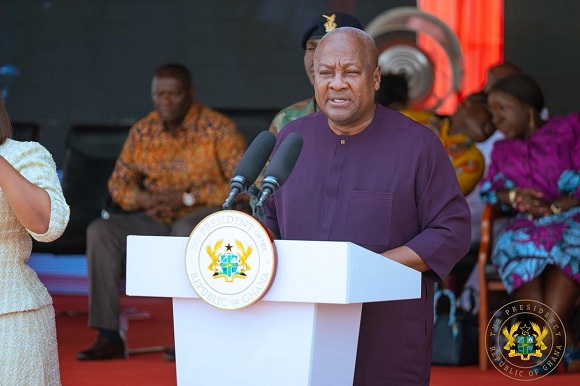
President John Dramani Mahama made this statement on Friday during the commissioning of the B5 Plus Steel Ball Mill and Section Mill manufacturing plant at La in Accra.
He explained that Ghana’s mining sector, which produces gold, bauxite, manganese, and lithium, requires substantial steel inputs for crushing and grinding, structural reinforcements, heavy equipment maintenance, and mineral processing.
“Ghana’s mining sector, gold, bauxite, manganese, and lithium requires significant steel inputs for crushing and grinding, structural reinforcements, heavy equipment maintenance, and mineral processing. With expanding mineral processing initiatives and our commitment to local content in mining, domestic steel manufacturing will become strategically important,” President Mahama stated.
The President emphasized the need to integrate mining and metal processing into a coordinated industrial ecosystem to maximize value retention within the economy.
He noted that the expansion of B5 Plus strengthens domestic capacity to substitute steel imports, save foreign exchange, improve trade balance, stabilize supply chains, and reduce exposure to global price volatility.
President Mahama disclosed that Ghana’s annual steel demand is estimated at over 1.2 million metric tons, driven mainly by construction, energy infrastructure, mining, and manufacturing.
He said historically, a substantial portion of this demand has been met through importation, which has placed pressure on the country’s foreign exchange reserves.
The President explained that under the Big Push Infrastructure Program, the government is investing heavily in roads and highways, railway modernization, bridges and interchanges, energy transmission lines, affordable housing, and industrial parks, all of which require iron and steel.
He noted that Africa is projected to require over $100 billion annually in infrastructure development, with West Africa alone facing substantial infrastructure deficits.
“If Ghana develops a strong steel base, we not only build our own roads and bridges, we will also supply steel to the whole sub-region. This is how infrastructure becomes industrial strategy,” President Mahama stated.
He explained that steel production benefits from continuous operation to reduce energy wastage, improve furnace efficiency, lower unit production costs, and maximize asset utilization.
President Mahama disclosed that the government has allocated GH¢110 million in the 2026 budget to operationalize the 24-hour initiative program, reflecting the administration’s seriousness about the policy.