
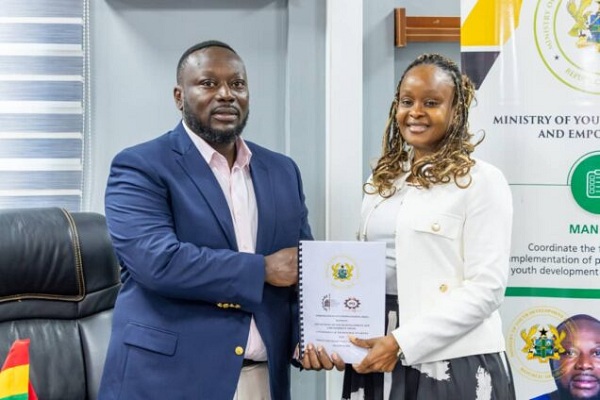


The Minister for Youth Development and Empowerment, George Opare Addo, Esq, has described the partnership between the Ministry of Youth Development and Empowerment (MYDE) and the Design and Technology Institute (DTI) as “a strategic investment in Ghana’s future,” stressing that equipping young people with relevant skills and opportunities is critical to the country’s industrialisation and long-term economic transformation.
Speaking at the signing of a five-year Memorandum of Understanding (MoU) with the President of DTI, Constance Elizabeth Swaniker, on Tuesday, August 4, Mr. Opare Addo said Ghana’s youthful population remains the nation’s greatest asset and that investing in their development would position the country for sustainable growth.
He noted that many young Ghanaians continue to face limited employment opportunities, skills mismatch, inadequate access to information, weak technology and start-up support, and other socio-economic challenges.
According to him, addressing these issues requires stronger collaboration between government and institutions with proven expertise in skills development and innovation.
Under the agreement, MYDE will provide policy leadership and coordinate implementation through national youth development platforms, while DTI will leverage its expertise in competency-based training, curriculum innovation, workforce development and industry engagement.
The partnership will expand access to technical and vocational education, structured internships, entrepreneurship programmes and digital skills training to better prepare young people for the demands of the modern labour market.
A major component of the collaboration is the adoption of DTI’s Precision Quality™ framework, which promotes professionalism, productivity, workplace discipline, safety and quality consciousness.
The initiative will also strengthen communication, leadership, teamwork, customer service, critical thinking, emotional intelligence and financial literacy, while providing mentorship, coaching and business incubation to encourage youth entrepreneurship.
Mr. Opare Addo said the partnership would complement existing government youth initiatives rather than duplicate them, adding that both institutions would work together to mobilise support from government, the private sector, development partners and international organisations to expand youth-focused employment and skills programmes.
President of the Design and Technology Institute, Constance Elizabeth Swaniker, underscored the importance of closer collaboration between industry and government to bridge the gap between education and the labour market.
She said DTI remains committed to delivering competency-based training that produces graduates with both technical expertise and the professional attitudes required by employers, noting that the partnership would help build an industry-ready workforce capable of driving Ghana’s industrial growth.
Also speaking at the ceremony, the General Secretary of the Christian Council of Ghana, Rev. Dr. Cyril G. K. Fayose, described youth development as a shared national responsibility, saying the Church and the State must work together to build a generation that is skilled, patriotic, morally grounded and prepared for the digital age.
He said Ghana’s growing youth population presents a significant demographic advantage that must be harnessed through deliberate investment in education, skills development, entrepreneurship and ethical leadership.
While acknowledging the opportunities created by technology, Rev. Dr. Fayose cautioned that digital advancement must be accompanied by integrity, patriotism and responsible citizenship.
Highlighting what he described as five priority areas for national youth development, Rev. Dr. Fayose called for the promotion of ethical digital leadership, deliberate investment in Ghana’s demographic dividend, expanded access to digital education, strengthened Technical and Vocational Education and Training (TVET), and increased youth participation in governance and constitutional reforms.
He further pledged the Christian Council of Ghana’s commitment to supporting government through its nationwide network of churches, schools, health institutions and community structures to advance civic education, leadership development and skills training, expressing confidence that sustained collaboration would produce a generation of young people equipped to contribute meaningfully to Ghana’s sustainable development.