
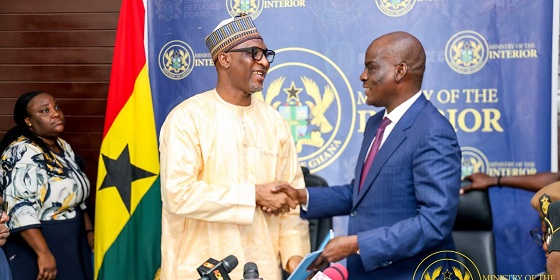


The Ministries of the Interior and Education have signed a Memorandum of Understanding (MoU) to enable the production and supply of a minimum of 30 per cent of sanitary pads, school uniforms, and furniture for schools across Ghana through the Ghana Prisons Service.
The ceremony, held at the Ministry of Interior in Accra, formed part of Government’s broader agenda to strengthen local production, promote value for money, and enhance inmate rehabilitation while supporting the education sector.
Speaking at the ceremony, the Minister for the Interior, Hon. Muntaka Mohammed-Mubarak, described the initiative as a deliberate policy choice that places education at the centre of national development. He emphasised the need to strengthen local production capacity, ensure the timely supply of essential educational materials, and anchor public procurement within state-owned institutions to promote transparency and accountability.
According to the Minister, the initiative would deliver interlinked outcomes, including improved inmate rehabilitation, skills development, income generation, and a reduction in recidivism. He announced that a five-member implementation committee would be established to oversee the effective execution of the agreement and commended the Ghana Prisons Service for embracing its expanded role in national development.
The Minister for Education, Hon. Haruna Iddrisu, in his remarks, said that the MoU will reposition the Ghana Prisons Service with new responsibilities within the education value chain. He described recidivism as a relapse into crime and stressed the importance of preventing unproductive inmate life through structured skills acquisition and productive engagement.
He noted that the initiative adopted a value-chain approach rooted in indigenous and local production, including the siting of productive entities within prison facilities.
The Director-General of the Ghana Prisons Service, Mrs. Patience Baffoe-Bonnie described the initiative as a game changer for the Service, noting that it had repositioned the Ghana Prisons Service as a key contributor to national production.
She stated that the ultimate goal of the initiative was to ensure public safety by breaking the cycle of recidivism and enabling inmates to transition into law-abiding and productive lives after incarceration.