
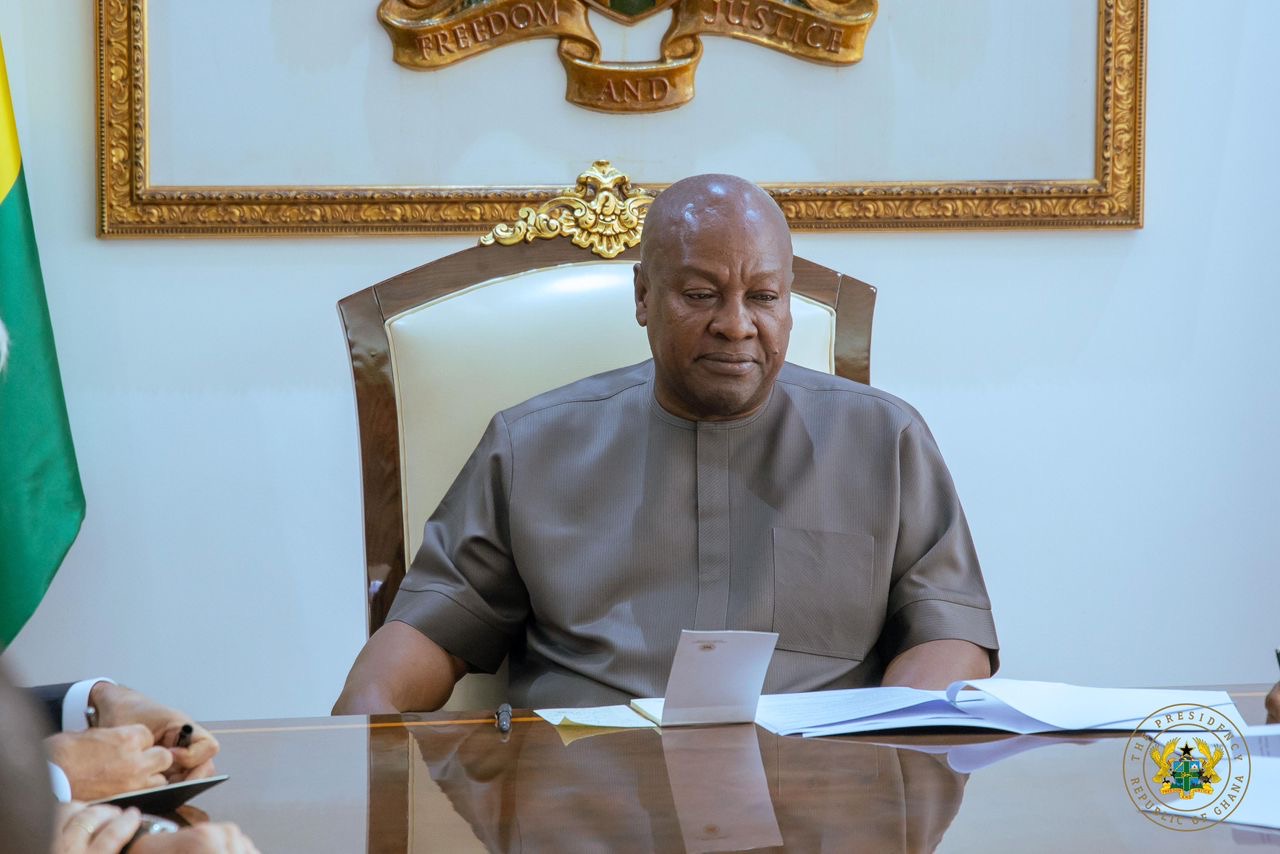


President John Dramani Mahama has indicated that government may reverse the moratorium on granting charters to private universities, following a courtesy call by the Private Universities Founders Association at the Jubilee House on Wednesday.
Speaking to the group, which included chancellors, deans, and professors from the private university sector, the President revealed that Cabinet had discussed extending the timeline for charter applications and was now considering making the chartering process optional.
“Cabinet rather talked about moratorium. We’re very anxious to hear from G-TEC, which is the body accredited to ensure quality education at the tertiary level,” Mahama said. “And so actually, the statement by the G-TEC supporting optional chartering, I think, brings some finality to the matter.”
The President acknowledged that implementing this change would require returning to Cabinet and amending the relevant legislation through Parliament, which he described as “an independent institution.”
The President also used the occasion to clarify remarks he made at Wisconsin that had been misinterpreted.
He explained that he was responding to a student who expressed concerns that affiliated universities without charters were at a disadvantage.
“I was responding to that student in that regard. So we must look at that concern the student expressed and be able to accommodate students like that,” he said, adding that he had played a video of his actual comments to provide proper context.
President Mahama warned that without addressing this issue, students might eventually prefer chartered private universities over those remaining as affiliates indefinitely.
“Because then there might come a time when students will opt for private universities that have chartered rather than those that continue to be affiliates in perpetuity. And so we need to look at issues like that,” he said.
The President praised the private university sector for its role in expanding access to tertiary education since 1998, when the pathway was opened for private institutions to complement government efforts.
“I must say, since the private universities came, they have done a yeoman’s job complementing what government has been doing,” President Mahama stated.
He recalled Ghana’s limited tertiary education options when only three public universities existed, the Kwame Nkrumah University of Science and Technology, the University of Ghana at Legon, and the University of Cape Coast.
The expansion began with Professor John Evans Atta Mills’ pledge that every region should have a public university, followed by the conversion of polytechnics into technical universities under then Education Minister and current Vice President Jane Naana Opoku-Agyemang.
President Mahama also noted his personal connection to the sector, having signed the first charter for a private university, Central University College, during his first term as president.
“Now that I’ve reincarnated, I don’t know how many more charters are going to come for signature,” he said.