
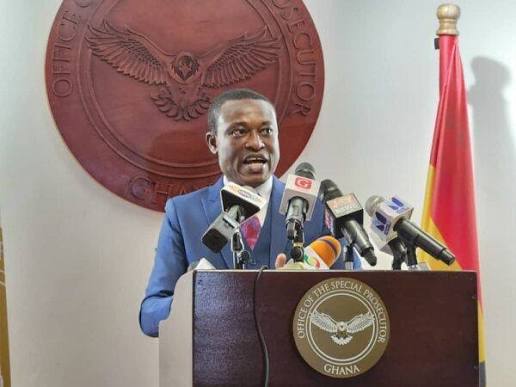


The Supreme Court has declared the Office of the Special Prosecutor (OSP) Act, 2017 (Act 959) constitutional.
In a judgement delivered today, Wednesday, July 29, 2026, the apex court held that Sections 3 and 4 of Act 959 are not inconsistent with, or in contravention of, the 1992 Constitution, and are therefore not void as filed by a citizen.
The suit, filed by private legal practitioner, Noah Ephraem Tetteh Adamtey, on December 12, 2025, questions whether Parliament exceeded its constitutional mandate by granting the OSP independent investigative and prosecutorial powers.
Adamtey’s lawsuit argues that the 1992 Constitution vests prosecutorial authority exclusively in the Attorney-General, citing Articles 88(3) and 88(4).
The case, numbered J1/3/2026, sought to strike down portions of the Office of the Special Prosecutor Act, 2017 (Act 959), which confer autonomous prosecutorial powers on the OSP. The Attorney-General’s office had supported Adamtey’s claim, arguing that the OSP’s independent prosecutorial powers were unconstitutional.
However, the Supreme Court has held that the responsibility for all prosecutions are vested exclusively in the A-G, and that any person other than the A-G who prosecutes in the name of the Republic does so only on the authority of the A-G.
It further ruled that the OSP holds an authorisation given by the A-G, in accordance with law, to initiate and conduct prosecutions, and that this authorisation subsists until it is amended.
In respect of matters brought by the OSP, the apex court ruled that the A-G retains the power to enter a nolle prosequi.
It also ruled that all prosecutions, convictions and freezing orders entered under Section 71 of the Act remain valid, and that nothing in the judgement impugns the authority of any prosecutor authorised by the A-G.