


Three bilateral agreements formalizing cooperation between Ghana and Saint Kitts and Nevis have been signed, covering political consultation, visa exemption for ordinary passport holders, and recruitment of Ghanaian medical professionals.
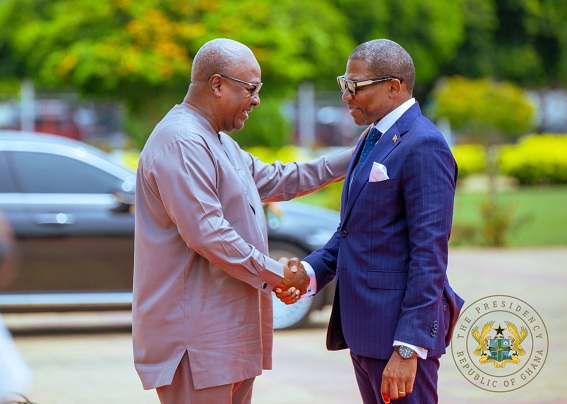
The signing ceremony took place on Wednesday at the Presidency in Accra when President Mahama hosted the Prime Minister of Saint Kitts and Nevis, The Honourable Dr. Terrance Michael Drew.
The first agreement establishes a Memorandum of Understanding on the Establishment of a Political Consultation Mechanism Between the Government of the Republic of Ghana and the Government of the Republic of St. Christopher (Kitts) and Nevis.
The second is an Agreement between the Government of the Federation of Saint Kitts and Nevis and the Government of the Republic of Ghana on Visa Exemption for Holders of Ordinary Passports.
The third agreement is a Bilateral Labour Agreement Between the Government of the Republic of Ghana and the Government of the Federation of Saint Kitts and Nevis for the Recruitment of Ghanaian Medical Professionals.
President Mahama stated that the visa exemption agreement extends the previous 2018 visa waiver, which covered only diplomatic and service passports, to include ordinary passport holders.
He described the extension as a practical and transformative step that will substantially facilitate tourism, trade, business exchanges, and people-to-people connections.
The President disclosed that the bilateral labour agreement formalizes Ghana’s commitment to support Saint Kitts and Nevis with skilled healthcare professionals within mutually beneficial frameworks.
Prime Minister Drew expressed appreciation for the three agreements, stating that the visa exemption removes barriers that previously forced Caribbean people to travel through northern countries to reach Ghana.
He revealed that the bilateral labour agreement addresses a dire need in the Caribbean, where there is a scarcity of healthcare professionals, while Ghana has a surplus of well-trained medical personnel.
The Prime Minister disclosed that Ghanaian nurses began working in Saint Kitts and Nevis three to four weeks ago and have been well-received by the population.
“I have been asked to ask His Excellency, the President, for more Ghanaian nurses. And so after this visit, we will have, to some extent, or at least in a framework of nurses coming to Saint Kitts and Nevis in a greater quantity this year,” Prime Minister Drew stated.
He described the labour agreement as delivering tangible benefits, with Ghana supplying skilled labor and Saint Kitts and Nevis receiving upgraded healthcare services for its people.
The Prime Minister noted that the political consultation mechanism will formalize regular government engagement on issues of mutual interest and shared international concerns.
President Mahama stated that beyond the three agreements, Ghana and Saint Kitts and Nevis have identified key sectors for deeper cooperation, including tourism development, climate-resilient agriculture, renewable energy, blue economy initiatives, and cultural industries.
He noted that the African-Caribbean Trade and Investment Forum (ACTIF) and the African Continental Free Trade Area provide immediate platforms to expand trade and investment partnerships.
The President stated that the goal is to position Ghana and St. Kitts and Nevis as model partners demonstrating the potential of South-South cooperation.
Prime Minister Drew announced that additional people-to-people connections are being established, including a planned visit by St. Kitts and Nevis’ national choir to Ghana for a cultural extravaganza and ongoing discussions for student exchange programmes.
He stated that his visit represents a homecoming rather than merely an official diplomatic engagement, noting the striking similarities between the two nations.
The Prime Minister commended President Mahama for championing a United Nations resolution to recognize the transatlantic slave trade and colonization as one of the most heinous crimes committed by humanity against itself.
“You can count on us for strong and full support. I am now chair of CARICOM, which are all of the countries in the Caribbean region, and I have considered this my responsibility to get CARICOM on board and the deliberations have started,” Prime Minister Drew stated.
President Mahama expressed appreciation for CARICOM’s principled stance on reparative justice and Ghana’s opportunity to address CARICOM leaders on the resolution.
He commended Prime Minister Drew for his leadership of CARICOM and the successful hosting of the 50th regular meeting of the Conference of Heads of Government of CARICOM in St. Kitts and Nevis.
The President stated that Ghana recognizes the vulnerabilities small island developing states face from climate change, rising sea levels, food insecurity, and external economic shocks.
He declared Ghana’s solidarity with St. Kitts and Nevis in advocating for climate justice, equitable access to climate finance, and reform of global financial institutions to reflect developing nations’ realities.
Prime Minister Drew stated that the three agreements and broader cooperation framework demonstrate that the time has come for the Caribbean-Africa relationship to move to the next level.
“Our generation has the responsibility to respond. So let us work together to continue to build the relationship between Africa and the Caribbean, Ghana and St. Kitts and Nevis,” the Prime Minister said.
President Mahama noted that Prime Minister Drew is the first Prime Minister of St. Kitts and Nevis to make an official visit to Ghana, charting a new and historic course in bilateral relations.
He stated that though the Atlantic Ocean separates the two nations, they remain united by history, ancestry, culture, and spirit.
The President declared that artificial mental and economic barriers that long separated Africa and the Caribbean must give way to bridges of trade, mobility, knowledge exchange, and cultural renewal.