
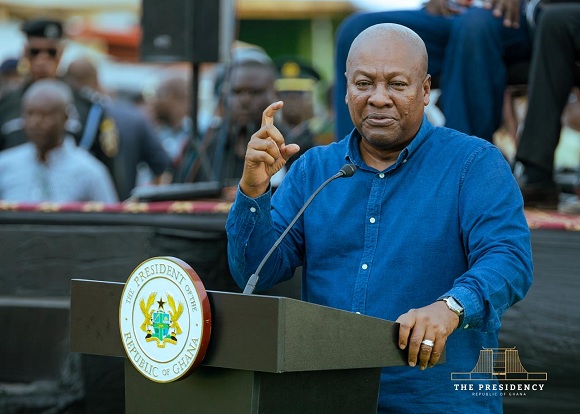


President John Dramani Mahama has announced government’s plan to achieve greater self-sufficiency in pharmaceutical production within the next five years, reducing Ghana’s dependence on imported medicines and strengthening the domestic pharmaceutical industry.
According to the President, Ghana currently imports about 70 percent of the medicines used in the country, despite having the capacity to produce many of those medicines locally.
He said the government was determined to reverse the situation by supporting local pharmaceutical manufacturers to expand production for both domestic consumption and export to neighbouring countries.
President Mahama made the announcement at a Free Primary Healthcare durbar at the Zuarungu Health Centre in the Upper East Region, where he said representatives of the National Vaccine Institute, the Ministry of Health and allied institutions, including the Pharmaceutical Association of Ghana, had recently presented a five-year plan for achieving pharmaceutical self-sufficiency.
He said the plan was aimed at growing Ghana’s pharmaceutical industry and creating the capacity to produce a wider range of medicines locally.
“As I was listening to the presentation, I learnt that we currently import about 70 per cent of the medicines we use. Yet, we have the capacity to produce many of those medicines here ourselves,” President Mahama said.
He explained that increasing domestic production would help reduce the cost of procuring medicines and make it easier for government to provide essential medicines under the Free Primary Healthcare Programme.
The President said government had already signed agreements with pharmaceutical manufacturing companies to ensure the availability of medicines while the local manufacturing capacity was being expanded.
He said patients requiring medicines for conditions such as hypertension and diabetes would continue to receive the necessary prescribed medication under the healthcare interventions.
President Mahama said the pharmaceutical self-sufficiency plan formed part of a broader effort to build a resilient and self-reliant health system capable of meeting the healthcare needs of Ghanaians while creating opportunities for exports.
The initiative is also consistent with the President’s broader call for African countries to strengthen domestic health systems and reduce dependence on external sources for essential medical supplies. In July 2026, President Mahama called for greater African self-reliance in medicines, vaccines and healthcare infrastructure.
He said achieving greater local production would not only improve access to medicines but also strengthen Ghana’s capacity to respond to future health emergencies and reduce vulnerabilities associated with international supply disruptions.
The President linked the pharmaceutical initiative to the Free Primary Healthcare Programme, under which health workers are visiting households to conduct basic health checks, identify illnesses early and refer patients to health facilities where necessary.
He said the availability of medicines was an important component of the programme, particularly for patients diagnosed with conditions such as hypertension and diabetes.
President Mahama said the government would continue investing in the health sector to ensure that Ghanaians had access to quality healthcare regardless of where they lived.
He reiterated that healthcare investment should be viewed as an investment in the country’s development, stressing that a healthy population was necessary to build a prosperous nation.
Ghana’s drive towards greater pharmaceutical self-sufficiency also builds on ongoing efforts to strengthen domestic vaccine manufacturing. In 2025, President Mahama announced additional government funding for the National Vaccine Institute as part of efforts to achieve vaccine self-sufficiency by 2030.
The President said government would continue to support initiatives aimed at strengthening local production, improving healthcare access and ensuring that essential medicines were available to patients at affordable cost.