


The Majority has dismissed claims by the Minority regarding the Bank of Ghana’s 2025 audited financial statements, describing them as “misleading” and based on a “flawed interpretation” of the accounts.
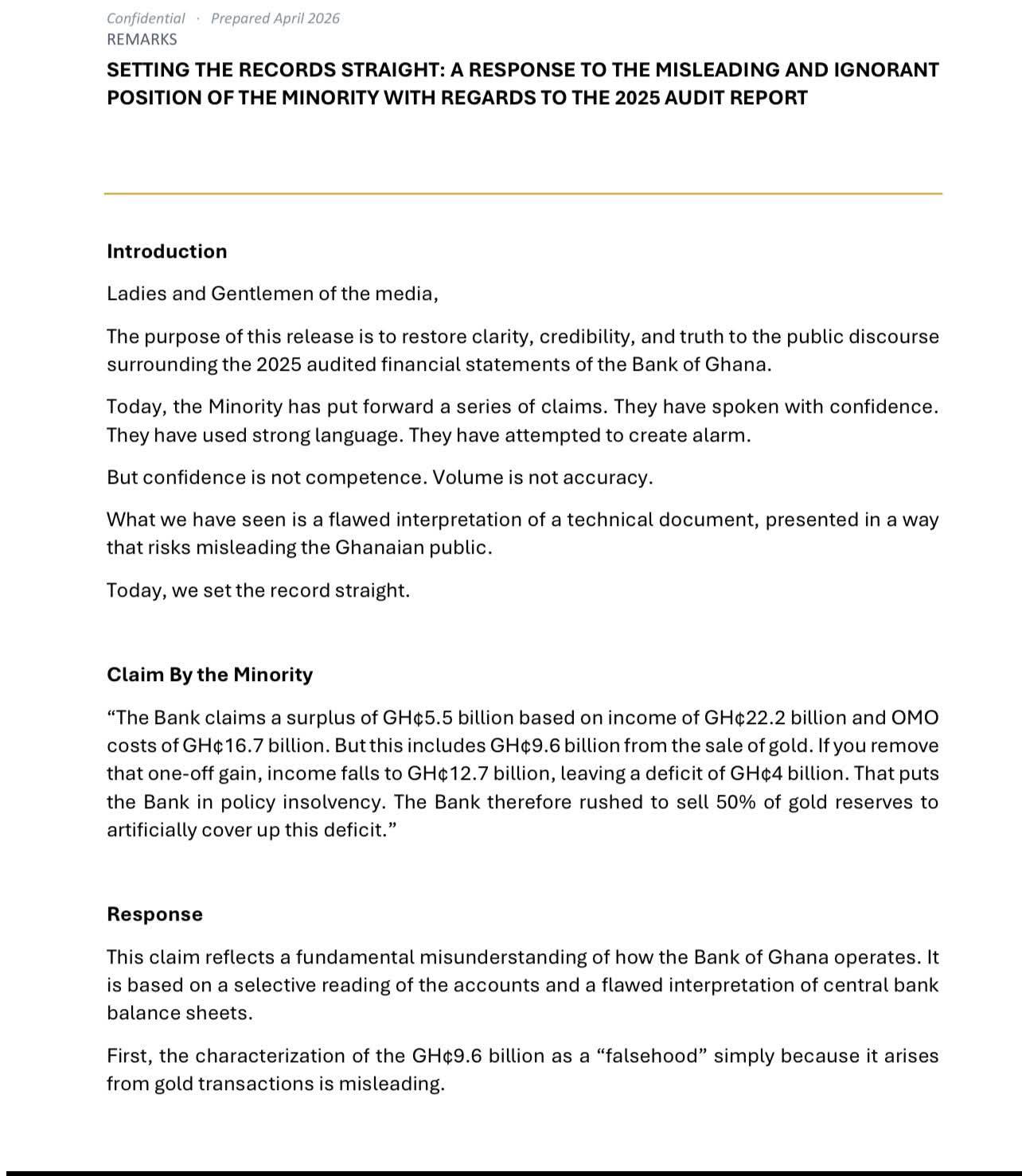
In a press release titled “Setting the Records Straight,” issued on Sunday, May 3, 2026, the Majority said the Minority’s analysis risks creating unnecessary alarm about the central bank’s financial position.
“The purpose of this release is to restore clarity, credibility, and truth to the public discourse surrounding the 2025 audited financial statements of the Bank of Ghana,” the statement said.
The Minority had argued that the Bank’s reported GH¢5.5 billion surplus was artificially inflated by a GH¢9.6 billion gain from gold sales, insisting that excluding the one-off income would leave the Bank with a GH¢4 billion deficit.
But the Majority rejected this assertion, describing it as a misunderstanding of central banking operations.
“The characterization of the GH¢9.6 billion as a ‘falsehood’ simply because it arises from gold transactions is misleading,” the statement stressed.
It explained that the central bank’s management of gold reserves falls within its core mandate, noting that “gains from such portfolio management are legitimate income” and “non-recurring does not mean illegitimate.”
According to the Majority, the claim that the Bank is “not in the business of trading gold” oversimplifies its role.
“The Bank is not a speculative trader. But it is fully engaged in reserve management,” it said, adding that rebalancing assets—especially during periods of high gold prices—is standard global practice among central banks.
The statement further justified the move as prudent in the face of economic pressures, noting that converting gold into liquidity “strengthens the Bank’s operational capacity and supports macroeconomic stability.”
On the issue of “policy insolvency,” the Majority argued that the Minority’s approach of stripping out the gold income to calculate a deficit is fundamentally flawed.
“Central banks are not commercial institutions. Policy solvency is not determined by a single year’s operating income minus expenses,” the release noted.
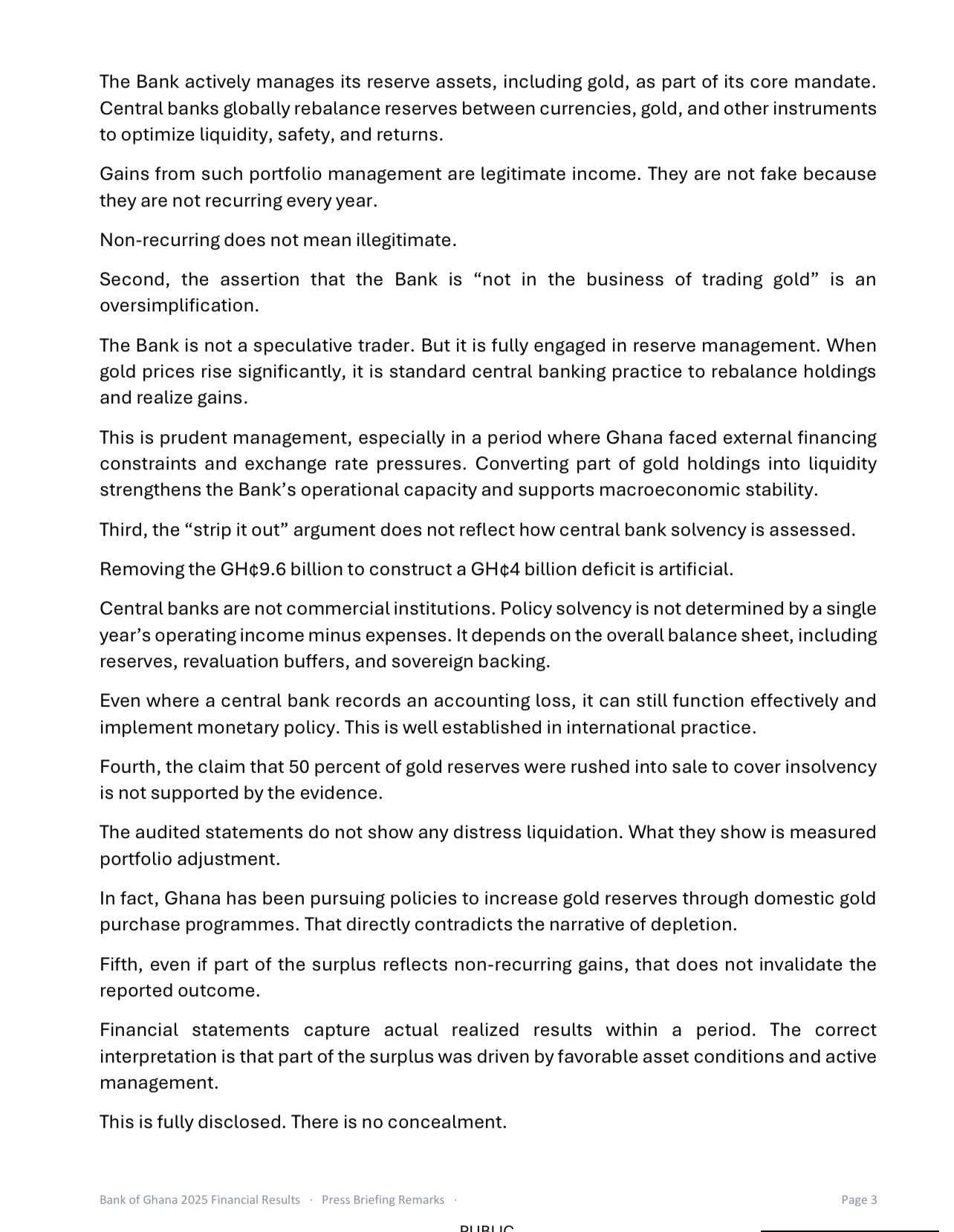
It added that even where central banks record accounting losses, they can still function effectively, citing established international practice.
The Majority also dismissed claims that the Bank rushed to sell 50% of its gold reserves to cover up financial difficulties.
“The audited statements do not show any distress liquidation. What they show is measured portfolio adjustment,” it clarified.
It further pointed to ongoing efforts to build reserves through domestic gold purchase programmes, saying this “directly contradicts the narrative of depletion.”
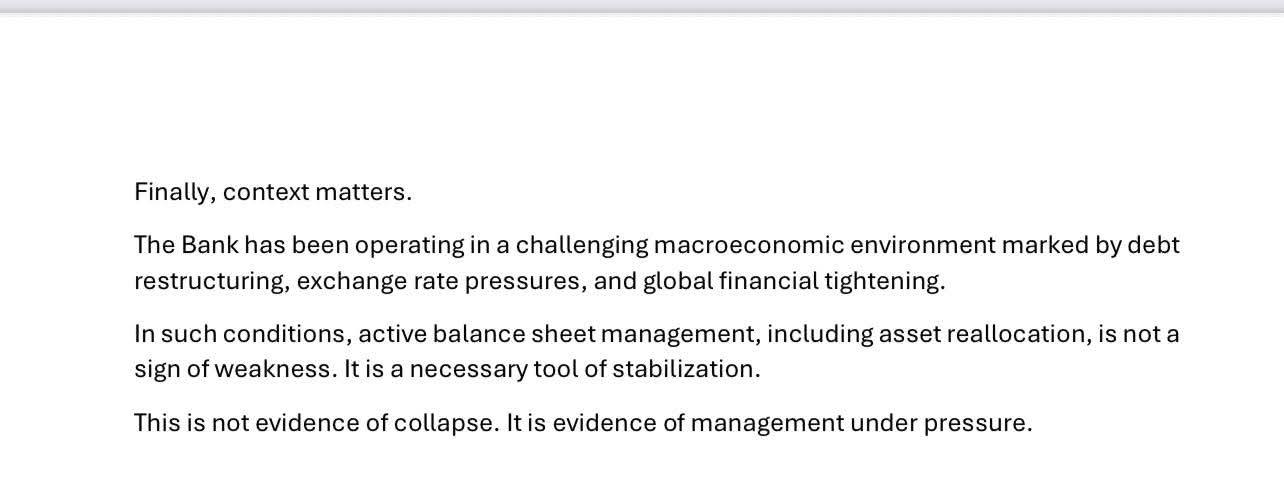
Placing the Bank’s performance in context, the Majority said the central bank has been operating under significant macroeconomic strain, including debt restructuring and exchange rate pressures.
“In such conditions, active balance sheet management, including asset reallocation, is not a sign of weakness. It is a necessary tool of stabilization,” the statement concluded.
“This is not evidence of collapse. It is evidence of management under pressure.”