
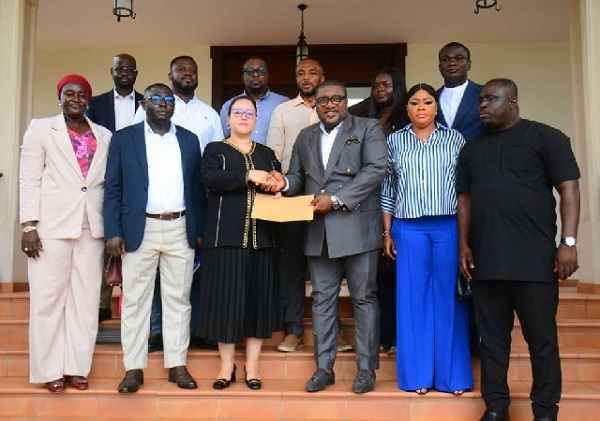


The New Patriotic Party (NPP) has petitioned members of the diplomatic community in Ghana over what it describes as growing state-sponsored political persecution, the criminalisation of free speech, and the erosion of democratic freedoms.
According to the party, the petition is intended to draw international attention to alleged acts of intimidation, harassment, and politically motivated actions targeting members of the opposition.
The NPP claimed recent developments in the country raise concerns about freedom of expression, political tolerance, and the protection of civil liberties under Ghana’s democratic system.
Party officials, led by National Organiser Henry Nana Boakye, presented the petition on Tuesday, May 19 and argued that certain actions by state institutions against opposition figures and party members threaten democratic accountability and could weaken public confidence in governance structures.
The petition urges the diplomatic community to closely monitor the situation and support efforts aimed at protecting democratic principles, human rights, and the rule of law in Ghana.
The NPP further maintained that safeguarding political freedoms and ensuring equal treatment under the law remain critical to preserving Ghana’s democratic reputation both locally and internationally.
Read the full petition below:
PETITION BY THE NEW PATRIOTIC PARTY (NPP) TO THE DIPLOMATIC COMMUNITY IN GHANA ON THE GROWING STATE-SPONSORED POLITICAL PERSECUTION, CRIMINALIZATION OF DISSENT, AND EROSION OF DEMOCRATIC FREEDOMS IN GHANA
19th May 2026
Your Excellencies,
We write, on behalf of the New Patriotic Party (NPP), to formally draw the urgent attention of the international diplomatic community to the growing and deeply troubling assault on democratic governance, constitutional liberties, political pluralism, and the rule of law in the Republic of Ghana under the administration of President John Dramani Mahama.
Ghana has long stood as a beacon of constitutional democracy and democratic stability on the African continent. Our country earned global admiration for its commitment to peaceful democratic transitions, freedom of speech, judicial independence, and respect for human rights. Successive governments, civil society actors, the media, and the international community collectively nurtured and strengthened these democratic gains over decades. Today, however, those hard-won democratic credentials are under serious threat.
The NPP is constrained to petition the diplomatic community because the Ghanaian people are increasingly witnessing a deliberate and systematic weaponization of state institutions against political opponents, journalists, social media commentators, and dissenting voices. The emerging pattern of intimidation, arbitrary arrests, selective prosecutions, politically motivated detentions, and suppression of free expression bears disturbing resemblance to the dark and painful periods of Ghana’s political history commonly remembered as the “culture of silence.”
What makes the current situation particularly alarming is that these actions are not isolated incidents. They form part of a broader and coordinated architecture of political persecution being executed through state security agencies, prosecutorial authorities, and increasingly, elements within the judicial system.
THE CRIMINALIZATION OF SPEECH AND DISSENT
Your Excellencies, the most disturbing feature of the present administration is the gradual resurrection of criminal libel and state-sponsored censorship through indirect means, despite Ghana’s historic repeal of the Criminal Libel and Seditious Laws in 2001.
That repeal, championed by the government of President John Agyekum Kufuor and spearheaded by then Attorney-General Nana Addo Dankwa Akufo-Addo, represented a defining moment in Ghana’s democratic development. It signaled Ghana’s firm commitment to press freedom, democratic accountability, and the decriminalization of political expression.
Regrettably, the current government appears determined to reverse those democratic gains through the strategic misuse of Sections 207 and 208 of the Criminal Offences Act, 1960 (Act 29), to criminally prosecute political speech and criticism of public officials.
Today in Ghana, opposition political communicators, journalists, activists, “facebookers,” and “tiktokers” are increasingly being arrested, detained, prosecuted, and intimidated for comments critical of government officials or state institutions. The state’s response to political criticism has shifted from democratic engagement to criminal prosecution.
This dangerous trend is exemplified by the recent arrest, prosecution, and remand of Mr. Kwame Baffoe, popularly known as “Abronye DC,” the Bono Regional Chairman of the NPP. Mr. Baffoe was arrested and arraigned before Circuit Court 9 in Accra on charges of “offensive conduct conducive to breach of peace” and “publication of false news” following comments he allegedly made criticizing a judge and questioning judicial impartiality.
Your Excellencies, without a doubt, since the assumption of office of the John Dramani Mahama-led National Democratic Congress (NDC) government on 7th January 2025, the nation has increasingly witnessed the brazen and continuous weaponization of state security institutions by government officials to settle personal scores with ardent critics of the government, particularly members and sympathizers of the New Patriotic Party (NPP). What is unfolding in Ghana today is not ordinary law enforcement; it is the systematic criminalization of dissent, political intimidation, and the deliberate suppression of opposition voices through the coercive machinery of the state.
At the risk of sounding repetitive, the following members and sympathizers of our Party are among the many victims of what can only be described as government-sponsored persecution, harassment, intimidation, and the criminalization of free expression:
- Mr. Kwame Baffoe alias “Abronye DC”;
- Rev. John Ntim Fordjour;
- Paul Adom-Otchere;
- Daniel Adomako alias “Sir Obama”;
- Mohammed Zakou;
- Yayra Abiwu;
- “Fante Comedy”;
- Mr. “Akyenkwa” of Wontumi TV;
- Okatakyie Afrifa;
- Kofi Ofosu Nkansah;
- Alfred Ababio Kumi alias “Adenta Kumi”;
- Gordon Asare Bediako;
- Abubakar Yakubu alias “Baba Amando”;
- David Essandoh.
- And several others
Your Excellencies, criticism of public officials, including members of the judiciary, is not a crime in a constitutional democracy. Where any individual, including a judge, believes that his or her reputation has been injured, Ghanaian law already provides civil remedies through defamation proceedings. The conversion of political criticism into criminal prosecution is therefore not a legal necessity. It is a political choice designed to intimidate and silence dissent.
Even more alarming in the case of Mr. Baffoe alias Abronye was the refusal by the Judge to grant him bail on the extraordinary basis that he might continue to make similar comments if released. In effect, a Ghanaian citizen was denied his liberty not because he had been convicted of any offence, but because he might continue to speak. Such reasoning offends the fundamental constitutional principles of personal liberty, freedom of expression, and the presumption of innocence guaranteed under the 1992 Constitution of Ghana.
ABUSE OF STATE SECURITY INSTITUTIONS
Your Excellencies, the abuse of state security agencies for partisan political purposes has now become deeply entrenched.
National Security operatives, the National Investigations Bureau (NIB), EOCO, and the Ghana Police Service are increasingly being deployed against opposition figures in dramatic “Rambo-style” arrests, midnight raids, dawn invasions of private residences, and prolonged detentions under onerous and punitive bail conditions.
Former government officials, opposition communicators, and critics of government are routinely subjected to humiliating arrests and public spectacles designed to intimidate both the individuals concerned and the broader opposition political class. The use of the NIB, Ghana’s intelligence and national security agency, as a detention facility for political opponents represents a particularly disturbing development.
The detention of Mr. Abronye DC in NIB custody for alleged speech-related offences cannot, by any objective standard, be justified as a matter of national security. It constitutes political intimidation through the machinery of the state. Further disturbing reports indicate that, days after the remand order was allegedly made, no signed and certified remand order had been produced by the court registry despite repeated requests by counsel for the accused. If true, this raises profound constitutional questions regarding the legality of the detention itself.
SELECTIVE JUSTICE AND POLITICAL DOUBLE STANDARDS
The selective and partisan application of the law has become impossible to ignore. While opposition members are swiftly arrested, detained, and prosecuted for alleged speech offences, members and officials associated with the governing National Democratic Congress (NDC) who engage in similar or more egregious conduct are routinely ignored by law enforcement agencies.
The NPP formally petitioned the Ghana Police Service concerning violent attacks and threats allegedly perpetrated against senior NPP officials during the Akwatia by-election by individuals associated with the NDC, including Chairman Awudu Sofo Azorka and Abdul Wahab Amadu, the NDC Constituency Communications Officer for Abuakwa North.
Despite the submission of substantial evidence, including public threats and physical assaults against opposition leaders, no meaningful action has been taken by the police to date. This selective administration of justice undermines public confidence in state institutions and erodes the constitutional guarantee of equality before the law.
THREATS TO JUDICIAL INDEPENDENCE
Your Excellencies, we are equally compelled to express our grave concern over the growing perception of Executive intimidation and encroachment upon judicial independence.The recent removal of Chief Justice Her Ladyship Justice Gertrude Araba Esaaba Sackey Torkornoo has generated widespread apprehension within legal and judicial circles regarding the independence of the judiciary and the security of judicial tenure. There is now a growing public perception that judges who render decisions unfavourable to the Executive risk professional victimization or political retaliation.
The denial of bail in politically sensitive matters, the apparent willingness of some courts to endorse punitive detentions for speech-related offences, and the increasing judicial deference to politically motivated prosecutions have further deepened concerns about the state of judicial independence in Ghana. The judiciary must remain the last line of defense between the citizen and the coercive powers of the state. Once public confidence in judicial neutrality is compromised, constitutional democracy itself becomes endangered.
A PATTERN OF POLITICAL PERSECUTION
Your Excellencies, the case of Abronye DC is not isolated. The NPP has documented multiple incidents involving the arrest, detention, intimidation, and prosecution of opposition figures for expressing political opinions or criticizing government officials.
These include:
- Mr. David Essandoh, NPP Agona West Constituency Organizer, arrested over a social media post regarding electricity outages;
- Mr. Abubakar Yakubu alias “Baba Amando,” arraigned and remanded on charges linked to political commentary;
- Mr. Alfred Ababio Kumi (“Adenta Kumi”), arrested following petitions and public commentary concerning judicial proceedings;
- Reverend John Ntim Fordjour, Member of Parliament for Assin South, subjected to attempted security action after raising concerns regarding matters of public interest and national security;
- Several journalists, social media commentators, and political activists perceived to be sympathetic to the opposition.
Taken collectively, these actions by State actors under this John Mahama administration reveal not isolated law enforcement activity, but a sustained pattern of political intimidation.
OUR APPEAL TO THE DIPLOMATIC COMMUNITY
Your Excellencies, Ghana’s democracy has long benefited from the vigilance, partnership, and principled engagement of the international community.
The NPP therefore respectfully calls upon the diplomatic community, development partners, international human rights organizations, and defenders of democratic governance to:
- Closely monitor the deteriorating human rights and democratic governance situation in Ghana;
- Publicly reaffirm the importance of freedom of expression, judicial independence, due process, and political pluralism in Ghana’s constitutional democracy;
- Engage the Government of Ghana on the increasing misuse of criminal prosecutions against opposition political speech and dissenting voices;
- Call for the immediate cessation of politically motivated arrests, prosecutions, arbitrary detentions, and intimidation of opposition figures, journalists, and activists;
- Encourage Ghanaian state institutions, particularly the judiciary and security services, to act strictly within constitutional limits and without partisan bias;
- Support efforts aimed at safeguarding democratic accountability, civil liberties, and the rule of law in Ghana.
CONCLUSION
Your Excellencies, this petition is not merely about one political party or one individual. It is about the future of constitutional democracy in Ghana. History teaches us that democratic erosion rarely occurs suddenly. It begins incrementally, with selective prosecutions, intimidation of critics, weaponization of state institutions, suppression of dissent, and the gradual normalization of fear.
The Ghanaian people fought too hard and sacrificed too much to escape authoritarianism for our democracy to now slide backward into a culture where citizens fear arrest and detention for expressing political opinions.
The NPP remains fully committed to constitutional democracy, the rule of law, peaceful political engagement, and the protection of fundamental human rights. We shall continue to defend these democratic values through lawful and constitutional means, and we trust that the international democratic community will stand with the people of Ghana in defense of liberty, justice, and democratic accountability.
The culture of silence must never return to Ghana.
Respectfully submitted,
FOR AND ON BEHALF OF THE NEW PATRIOTIC PARTY (NPP)
Justin Kodua Frimpong
General Secretary, NPP
Hon. Alexander Kwamena Afenyo-Markin Esq.
Minority Leader, Parliament of Ghana