
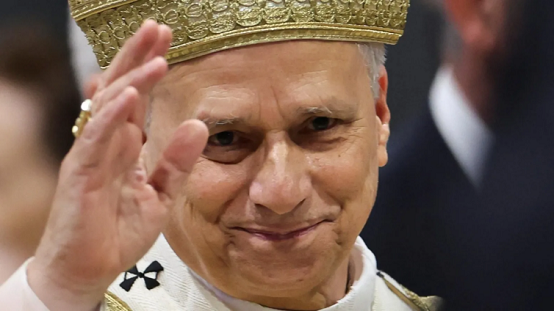


Pope Leo has responded to attacks by US President Donald Trump, saying he hoped to preach the Gospel and about peace, but that anyone was free to criticise him.
In his latest remarks about the pontiff, Trump suggested that he believed that it was okay for Iran to have a nuclear weapon.
The Pope has said no such thing, but he has opposed the US and Israel's war on Iran. His stance has angered Trump, prompting the US president to lash out repeatedly.
The latest exchange comes as US Secretary of State Marco Rubio heads to the Vatican for a two-day visit this week.
The State Department said Rubio would work to "advance bilateral relations" with Italy and the Vatican and discuss "the situation in the Middle East and mutual interests in the Western Hemisphere", including during meetings with other Italian counterparts.
On Tuesday, ahead of his visit, Rubio denied that he was going to Italy to smooth over tensions between Trump and the Vatican.
"It's a trip we have planned from before, and obviously we had some stuff that happened," he said, adding there was "a lot to talk about with the Vatican".
Earlier on Tuesday, Pope Leo said he would continue to call for peace despite criticism.
"The mission of the Church is to preach the Gospel, to preach peace," he said, according to Reuters. "If someone wants to criticise me for preaching the Gospel... I hope simply to be listened to because of the value of God's words."
Most recently, this week, Trump told conservative radio talkshow host Hugh Hewitt that the Pope was "endangering a lot of Catholics and a lot of people" because he "thinks it's fine for Iran to have a nuclear weapon". The Pope has not said he supports Iran having a nuclear weapon.
But Brian Burch, the US ambassador to the Holy See, told reporters this week that despite the recent tensions there was no "deep rift" between the US and the Vatican.
"Nations have disagreements, and I think one of the ways that you work through those is... through fraternity and authentic dialogue," Burch told journalists.
"I don't accept the idea that somehow there's some deep rift," he said, adding that Rubio's meetings in Italy could allow the two sides to "talk through" any differences.
The disagreement also led to tensions between Trump and Italian Prime Minister Giorgia Meloni – a former Trump ally – as she also criticised the war in the Middle East and came to the defence of the Pope.
Asked by reporters whether she would meet Rubio this week, Meloni said: "I think so."
Pope Leo has spoken out repeatedly against the conflict in the Middle East, saying last month: "As a pastor, I cannot be in favour of war."
"I would like to encourage all to make efforts to look for answers that come from a culture of peace and not from a place of hate and division," he said.
Trump answered the statements from the first US-born pontiff by calling the Pope "WEAK on crime" and "terrible for Foreign Policy".
"He wasn't on any list to be Pope, and was only put there by the Church because he was an American, and they thought that would be the best way to deal with President Donald Trump," Trump wrote on social media. "If I wasn't in the White House, Leo wouldn't be in the Vatican."
Trump also drew backlash when, just an hour later after making that statement, he posted an image depicting him as a Jesus-like figure, which was later removed. Trump acknowledged posting the picture, telling reporters he thought it was "me as a doctor".
Vice-President JD Vance – who converted to Catholicism – has also come to Trump's defence, saying the Vatican should "stick to matters of morality".
BBC