



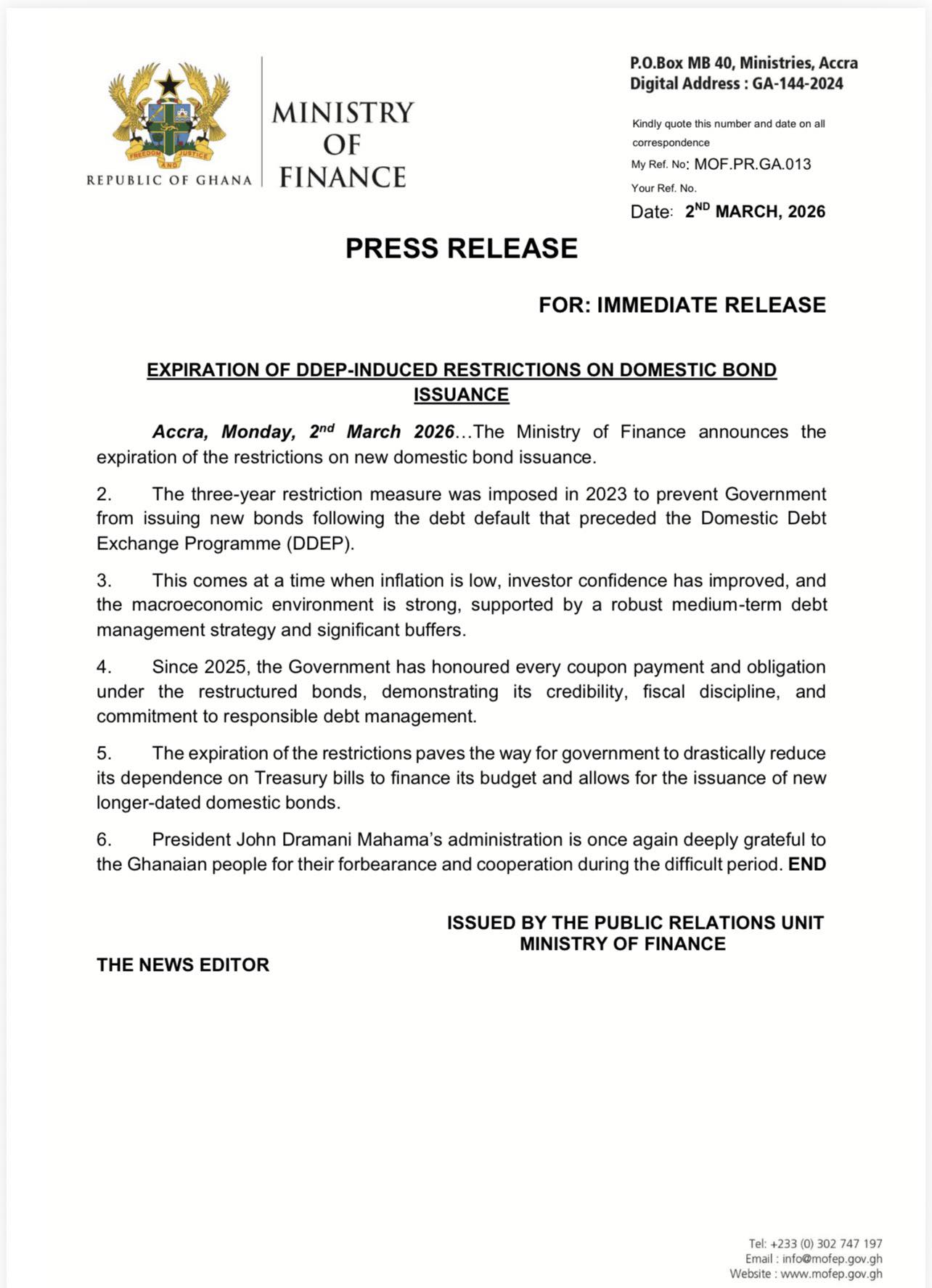
The Ministry of Finance has announced the expiration of restrictions on new domestic bond issuance, paving the way for government to return to the local bond market after three years of suspension.
In a statement issued on Monday, March 2, the Finance Ministry said the restrictions, introduced in 2023, had officially lapsed following improvements in the country’s macroeconomic conditions.
“The three-year restriction measure was imposed in 2023 to prevent Government from issuing new bonds following the debt default that preceded the Domestic Debt Exchange Programme (DDEP),” the statement noted.
According to the Ministry, the decision comes at a time when economic indicators have shown positive signs.
“This comes at a time when inflation is low, investor confidence has improved, and the macroeconomic environment is strong, supported by a robust medium-term debt management strategy and significant buffers,” the statement said.
The Ministry also highlighted government’s improved track record in meeting its financial obligations under the restructured debt programme.
“Since 2025, the Government has honoured every coupon payment and obligation under the restructured bonds, demonstrating its credibility, fiscal discipline, and commitment to responsible debt management,” it stated.
With the lifting of the restrictions, government is expected to shift away from its heavy reliance on short-term borrowing.
“The expiration of the restrictions paves the way for government to drastically reduce its dependence on Treasury bills to finance its budget and allows for the issuance of new longer-dated domestic bonds,” the statement explained.
The Finance Ministry further conveyed appreciation from the government to citizens for their support during the debt restructuring period.
“President John Dramani Mahama’s administration is once again deeply grateful to the Ghanaian people for their forbearance and cooperation during the difficult period,” it said.
Ghana’s domestic debt restructuring was introduced in late 2022 as part of emergency measures to stabilise the economy after the country defaulted on most of its external debt.
In December 2022, the Ministry of Finance (Ghana) launched the Domestic Debt Exchange Programme (DDEP), which required holders of government domestic bonds to swap their existing instruments for new ones with longer maturities and lower interest rates. The move was aimed at reducing government’s rising debt burden and easing pressure on public finances.
The restructuring became necessary after Ghana faced severe economic challenges, including high inflation, rapid currency depreciation, dwindling foreign reserves, and mounting debt servicing costs. By 2022, public debt had reached unsustainable levels, forcing the government to seek international support.
As part of negotiations for a financial support programme with the International Monetary Fund (IMF), Ghana committed to comprehensive debt restructuring, covering both external and domestic obligations.
The IMF required the country to restore debt sustainability before accessing bailout funds.
Under the DDEP, investors – including banks, pension funds, insurance companies, and individual bondholders – accepted new bonds with reduced coupon rates and extended repayment periods. While some exemptions were later granted to pension funds and individual investors, the programme initially sparked public protests and concerns over its impact on savings and financial institutions.
In 2023, following the restructuring and partial default, government imposed restrictions on new domestic bond issuance to prevent further debt accumulation and to rebuild investor confidence. During this period, the state relied heavily on short-term Treasury bills for financing.
Since 2025, government has gradually restored credibility by meeting coupon payments on the restructured bonds and improving fiscal discipline.
This progress, together with IMF-backed reforms and improved macroeconomic conditions, has helped rebuild confidence in the domestic bond market.