
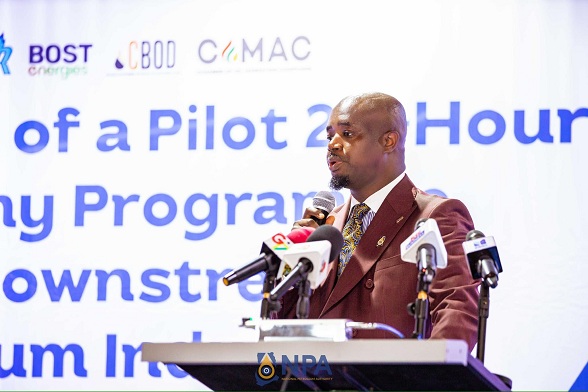


The National Petroleum Authority (NPA) has initiated a phased rollout of a 24-Hour Economy Programme within the petroleum downstream sector.
The pilot phase, beginning in Greater Accra, Ashanti, Western, and Northern regions, covers 268 fuel stations, eight petroleum depots, and two refineries.
The participating depots include BOST Depot in Kumasi, APD Global, Tema Tank Farm (TTF), Tema Fuel Company LTD (TFC), Vana Energy, and Quantum Terminals in Tema, as well as Ghanstock Depot and Zen Terminals in Takoradi.
The programme will also involve the Tema Oil Refinery and Sentuo Oil Refinery.
The pilot launch held in Accra on Tuesday, featured speeches and a trip to the JP Filling Station on the Spintex Road for a symbolic launch of the project led by officials of the NPA and the 24-Hour Economy Secretariat.
The event held on the theme “Powering Ghana’s 24-Hour Economy Through an Efficient Petroleum Downstream Sector” brought together key stakeholders from the petroleum industry and the 24-Hour Economy Secretariat as well the the security services.
Notable among the attendees were the Deputy Minister of Energy and Green Transition, Richard Djan Mensah, Presidential Advisor on 24-Hour Economy and Accelerated Export Development, Augustus Goosie Tanoh, CEO of NPA, Mr Godwin Edudzi Tamakloe and CEO of COMAC, Dr Riverson Oppong.
Speaking at the pilot launch, Chief Executive of the National Petroleum Authority, Godwin Kudzo Tameklo said the initiative aligns with President John Dramani Mahama’s vision for transformative economic growth through continuous operations and improved productivity.
He said the programme aims to ensure uninterrupted fuel availability, improve supply chain efficiency, create jobs, reduce congestion, and boost economic activity through round-the-clock operations.
Mr Tameklo added that the phased implementation will allow for system testing, operational refinement, and enhanced safety measures, supported by modern monitoring technology and collaboration with security agencies and private sector stakeholders.
"This programme envisions continuous operations across key installations, including bulk storage depots, refineries gantries, LPG stations, and retail outlets, ensuring that petroleum products are always available and accessible to Ghanaians," he said.
"The expected outcomes are clear: a more efficient and resilient petroleum supply chain, improved service delivery, expanded economic activity, and meaningful job creation."
"On behalf of the NPA, I reaffirm our unwavering commitment to the successful implementation of this pilot programme. Together, let us fuel Ghana’s progress, day and night," Mr Tameklo added.
Graphic