
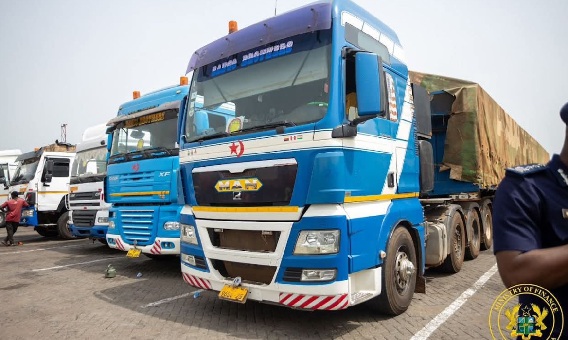


The Ghana Revenue Authority (GRA) has donated 39,256 jerry cans of confiscated vegetable cooking oil to the National School Feeding Programme after investigations uncovered widespread customs fraud linked to the consignment.
The donation follows the conclusion of investigations into the interception of 18 trucks which had been declared as transit cargo from Togo through Ghana to Niger.
The probe revealed falsified trade documentation, under-declaration of goods, incorrect tariff classification and other irregularities in the declaration process.
Addressing a media briefing in Accra yesterday, the Commissioner-General of the GRA, Mr Anthony Kwasi Sarpong, said the decision to allocate the confiscated goods to the School Feeding Programme was taken on the directive of the Ministry of Finance.
He explained that the trucks were intercepted in February at the Gorm barrier on the Tema Motorway by a joint team of Customs officers and National Security personnel, following intelligence that the cargo, declared as transit goods, was being diverted onto the local market.
Mr Sarpong said investigations established that export documents obtained from Togolese Customs showed that the goods originated from Malaysia and Indonesia and were destined for two companies in Abidjan, Côte d’Ivoire, contrary to declarations made at Ghana’s Akanu border that the final destination was Niger.
He indicated that the declarations processed at the border were not supported by bills of lading or export documents, but rather based on invoices claiming the goods had been purchased from the open market in Togo.
The investigations further revealed significant discrepancies in both the quantity and description of the goods.
While Customs records declared 35,246 jerry cans of vegetable cooking oil, a physical examination uncovered 39,256, representing an under-declaration of 4,010 jerry cans. In addition, a consignment declared as tomato paste was found to contain tomato seasoning powder.
Mr Sarpong said the cooking oil had also been wrongly classified under a tariff attracting a 20 per cent import duty instead of the applicable 35 per cent rate, resulting in a substantial understatement of the required bond guarantee.
He further disclosed that enquiries with the Nigerian Chamber of Commerce failed to verify the taxpayer identification details of the named consignee, Adamu Mumuni, raising concerns about the authenticity of the consignee.
A review of the Integrated Customs Management System (ICUMS), he said, uncovered 44 previous transit declarations linked to the same consignee, several of which lacked supporting bills of lading and exhibited similar irregular exit patterns at the Kulungugu border.
Mr Sarpong announced that four Customs officers involved in processing the consignment had been interdicted and were undergoing internal disciplinary proceedings, while investigations into the role of the clearing agent were ongoing.
He assured the public that the Customs Division had intensified compliance measures at the country’s borders to safeguard revenue and curb illicit trade, stressing that the Authority would continue to enforce the law against persons engaged in customs-related offences.