
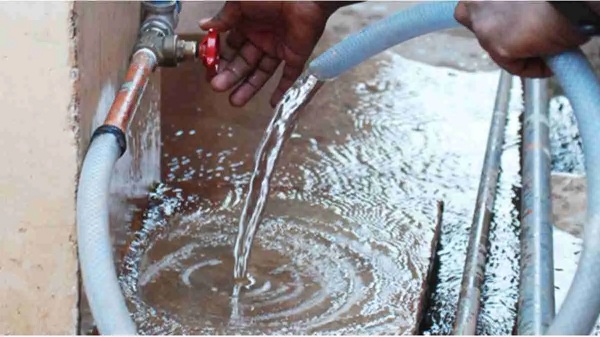


The Ghana Water Limited (GWL) has charged a total of GH¢8.6 million in penalties and outstanding bills following the detection of hundreds of illegal water connections across the country.
Out of the amount charged, GH¢2.1 million has already been recovered.
Adam Mutawakilu, the Managing Director of GWL, addressing a press conference in Accra on Wednesday, disclosed that intensified revenue protection operations conducted between August 2024 and December 2025 had uncovered widespread illegal use of treated water, resulting in significant commercial losses to the Company.
He said a total of 217 illegal connections were uncovered during the period under review, while 239 illegal connections had so far been detected to date through ongoing inspections and audits by specialised teams.
According to Mr Mutawakilu, the illegal activities ranged from direct connections to transmission lines, meter bypassing and tampering, to unapproved extensions of supply to commercial operations without billing.
“These practices convert treated water into zero revenue, yet the Company still bears the full cost of treatment, pumping, chemicals and maintenance,” he stated.
Out of the GH¢8.6 million charged to offending customers, Mr Mutawakilu noted that about GH¢3 million was traced to just two large-scale clients whose operations had bypassed proper metering and billing systems for extended periods.
He explained that although recovery efforts were ongoing, the GH¢2.1 million retrieved so far demonstrated the effectiveness of targeted enforcement and engagement when backed by accurate data and legal support.
The Managing Director described the findings as alarming but necessary, noting that they had provided a clearer picture of the scale of revenue leakages confronting the national water utility.
He said illegal connections not only deprived the Company of critical income, but also affected water pressure and supply reliability for law-abiding customers, particularly in densely populated urban areas.
Beyond financial losses, Mr Mutawakilu warned that illegal connections posed serious risks to public health, as unregulated pipes often compromised water quality and increased the likelihood of contamination.
He stressed that the challenge of illegal connections formed part of a broader problem of non-revenue water, which continued to undermine the financial sustainability of the Company.
As of December 2024, Ghana Water Ltd. Recorded non-revenue water levels of about 52 per cent, meaning that more than half of the treated water produced nationwide could not be properly accounted for.
Mr Mutawakilu explained that nationally, out of approximately 220 million gallons of water supplied daily, about 114 million gallons were lost through leakages, theft, meter inaccuracies and billing anomalies, leaving only 106 million gallons generating revenue.
In the Accra–Tema Metropolitan Area, he said of the 137 million gallons supplied daily, only 66 million gallons were accounted for, with the remaining volume lost to similar challenges.
He attributed the losses to a combination of technical and commercial factors, noting that while about 22 per cent of losses resulted from aging infrastructure, bursts and leakages, approximately 78 per cent were linked to commercial losses such as illegal connections, meter bypassing and water theft.
“These losses translate into wasted chemicals, wasted electricity and wasted effort,” the Managing Director said, adding that the situation was financially unsustainable.
He identified mounting customer indebtedness as a major constraint to efficient operations, revealing that outstanding arrears across various customer categories ran into billions of cedis nationwide.
According to him, unpaid water bills weakened the Company’s cash flow and limited its ability to procure treatment chemicals, pay electricity bills, maintain infrastructure and expand services to underserved communities.
“When bills are not paid, our capacity to deliver reliable water is compromised,” he said.
Mr Mutawakilu noted that Ghana Water Ltd. Also faced rising operational costs, including electricity, fuel, spare parts and chemicals, alongside the burden of maintaining aging infrastructure, much of which was decades old.
National daily water demand stands at about 350 million gallons, while existing treatment facilities can produce only 220 million gallons, leaving a deficit of 130 million gallons each day.
To address these challenges, the Managing Director said the Company had intensified revenue protection efforts while expanding digital payment platforms to make compliance easier for customers.
Mr Mutawakilu emphasised that while enforcement was being strengthened, the Company remained focused on customer education and regularisation, giving offenders the opportunity to legalise connections and enter structured payment arrangements.
He said the recovery figures reflected cooperation from some customers who, upon detection, opted to settle outstanding bills rather than face disconnection or prosecution.
The Managing Director stressed that the Company’s approach was not punitive but corrective, aimed at restoring fairness, accountability and sustainability in the water supply system.
“Every cedi lost through illegal connections directly reduces our capacity to improve services,” he said, adding that funds recovered were already being channelled into operational needs.
He called on the public to report suspected illegal connections in their communities, assuring that whistleblowers would be protected.
Mr Mutawakilu also appealed to customers with outstanding arrears to engage the Company early, noting that flexible payment options were available for those facing genuine financial difficulties.
GNA