
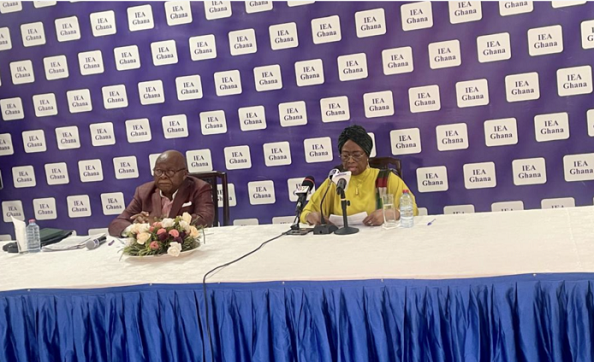


The Institute of Economic Affairs (IEA) has cautioned that the reduction of the Growth and Sustainability Levy could undermine Ghana’s efforts to maximise benefits from its natural resources.
At a press briefing in Accra, the policy think‑tank said the Government’s decision to cut the levy from three to one per cent, intended to cushion investors, departed from a global development shift anchored on ownership and enhanced national benefits.
Justice Sophia Akuffo, a Distinguished Fellow of the IEA, questioned the rationale behind the move.
“Why did government increase royalties, ostensibly to capture greater value from Ghana’s mineral wealth, only to simultaneously dilute that gain through tax concessions?” she asked.
Justice Akuffo, a former Chief Justice, said the reduction weakened the broader objective of ensuring that Ghana derived maximum benefit from its extractive sector, and called for coherent and predictable fiscal policies aligned with long‑term national interests.
She expressed concern that despite Ghana’s vast natural resources, the country had resorted to the International Monetary Fund for financial bailouts on multiple occasions.
Justice Akuffo described as worrying the recent announcement by the Minister of Finance on plans to borrow GHS17 billion to pay salaries, urging the leveraging of natural and mineral resources to drive the national development agenda.
She cited Botswana, Burkina Faso, Chile and Venezuela as examples of countries embracing new arrangements anchored on ownership, urging Ghana to adopt improved terms for resource extraction to secure long‑term benefits.
Botswana, Justice Akuffo noted, had increased state participation in its diamond industry to capture greater value, while Burkina Faso had adopted similar approaches in managing its natural resources.
“These developments have shown that asserting sovereignty does not repel investment; rather, it redefines the terms of engagement in favour of national development. They also show that Africans have woken up, and Ghana must join the awakening,” she said.
Justice Akuffo stressed that the expiration of over 30 mining leases, record highs in global mineral prices and discoveries of new critical minerals offered Ghana a once‑in‑a‑generation opportunity to reset its mineral resource governance framework.
She said this required engaging local and foreign private sector expertise through service contracts that preserved national control and maximised benefits for the country’s industrial transformation.
The IEA urged the government to adopt consistent fiscal policies that balanced investor confidence with national development priorities, to ensure that Ghana’s resource wealth translates into sustainable economic growth.
GNA