
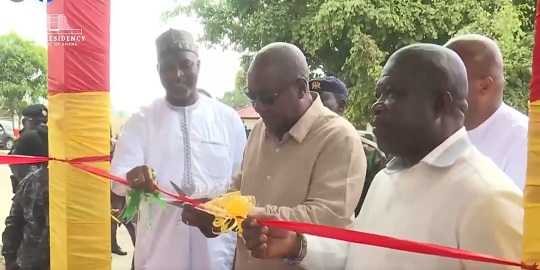


President John Dramani Mahama has inaugurated the Volta Regional Office of the National Signals Bureau (NSB) in Ho.
The NSB is a government agency that provides integrated signal systems to support national security and intelligence agencies.
Its functions include gathering and analyzing electronic and digital communications intelligence, providing secure communication networks for government agencies, protecting cyberspace, and supporting the prevention of serious crimes like kidnapping, fraud, and armed robbery.
President Mahama, in his remarks, noted that the inauguration of the National Signals Bureau Regional Command Center in Volta region was so critical, because it would provide real-time monitoring, cybersecurity protection, border area surveillance, and early warning systems that safeguard the investments and enterprises operating within the Government’s new 24-hour framework.
He said although the NSB was a relatively young institution within the national security architecture, it had rapidly evolved into a technologically agile and mission-focused agency.
The President said its expanding footprints at the regional and district levels aligned perfectly with the government’s commitment to enhancing local-level intelligence, strengthening community security, and modernizing national surveillance capacity.
“Today’s inauguration is therefore not just a ceremony. It marks a decisive step in reinforcing the foundations of a modern, resilient, and data-driven national security system, one that is capable of anticipating threats rather than merely reacting to them,” he stated.
He also noted with appreciation the collaborative efforts of the Volta Regional Minister and the traditional leaders of the Volta Region.
President Mahama said the Volta Region would build Ghana’s next generation of cyber and signals intelligence; adding that it would strengthen counterterrorism capabilities and position us at the regional training hub for ECOWAS, allied African nations, and global partners.
He said it would cement their leadership in technological and intelligence training.
President Mahama said the intelligence training center was not going to be only for Ghanaians but for African countries that wanted to send their students to be trained in signals and intelligence surveillance.
“This is a forward-looking initiative and one that will define the future of Ghana’s intelligence ecosystem,” he said.
He said as part of government’s long-term vision to modernize national security, it was investing significantly in technology infrastructure and capacity enhancement across the intelligence sector.
He said these investments include deployment of 60,000 additional surveillance cameras across the length and breadth of our nation, installation of 500 new 4G and 5G communication sites, upgrading an integrated national security communication system using advanced analytics and artificial intelligence, and construction of a new data surveillance and cyber defence centre in Accra to serve as the headquarters of the National Signals Bureau, and the expansion of modernized regional command centres just like the Ho one across the length and breadth of the country.
He said together, these upgrades would strengthen collaboration among security and intelligence agencies, better protect digital and financial systems, and enhance the ability to respond swiftly to emerging threats.
The President praised the gallant men and women of the National Signals Bureau, saying “your work, often unseen but always very impactful, forms the backbone of Ghana’s security”.
“Your professionalism, your discipline, and loyalty to the Republic are commendable.”
President Mahama reaffirmed a timeless truth that security was the foundation of development and that intelligence was the backbone of security, and the National Signals Bureau was central to building a competitive, technologically driven, 24-hour productive economy.
GNA