
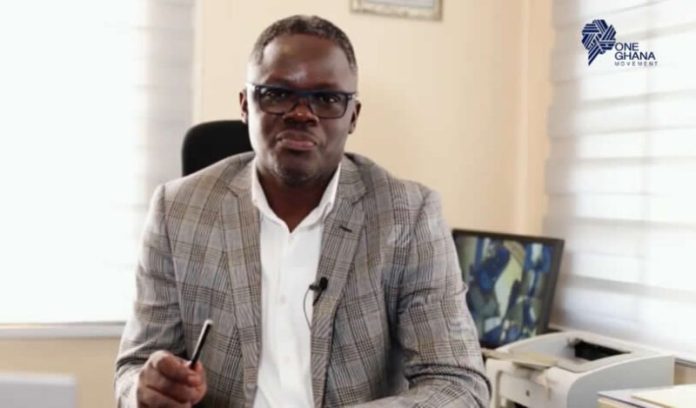


Private legal practitioner, Samson Lardi has reacted to Otumfuo's rejection of sections of the new Lands Act.
Otumfuo has raised concerns about some sections of the Act that demands accountability from Chiefs.
Explaining reasons he thinks the new Lands Act is the best, Samson Lardi said: "This law that has been made and as has been prayed by people like lawyer Kwame Djan and Judges of the court who have also sought to educate us on, is touted as one of the best for purposes of ensuring sanity in land administration in the country."
"Now the provision in question is actually a re-rendition of a constitutional provision in Article 36 (8) which says 'The State shall recognize that ownership and possession of land carry a social obligation to serve the larger community and, in particular, the State shall recognize that the managers of public, stool, skin and family lands are fiduciaries charged with the obligation to discharge their functions for the benefit respectively of the people of Ghana, of the stool, skin, or family concerned and are accountable as fiduciaries in this regard.'
"A fiduciary is simply someone who is a trustee, who is holding property on your behalf. If you are a fiduciary you have the obligation to act solely for the person's benefit so Chiefs as stated in the constitution, occupants of stools, skins, and family heads are trustees and in managing lands are fiduciaries," he added.
The Asantehene, Otumfuo Osei Tutu II has rejected a section of the Lands Act 2020 that empowers the citizenry to take chiefs to court to account for land sales.
The Act puts the traditional authority in a fiduciary role over lands and empowers subjects to demand accountability over the use of proceeds from land sale.
But the Asantehene, at a meeting between the Ashanti Region House of Chiefs and the Ministry of Lands and Natural Resources stated areas under his leadership are exempt in the application of the Act.
The Minister for Lands and Natural Resources, Samuel Abu Jinapor, led a team from the Ministry to explain the new Lands Act to the Ashanti Region House of Chiefs in their last meeting of the year.
This was at the request of the Council.
One of the principal issues that came up was the power the new act gives to the subjects over the sale of land.
“In the new Act, the chiefs are caretakers on the lands. They hold it in trust. So their subjects can demand accountability even in court. In many areas, chiefs misappropriate income from the sale of land”, Samuel Abu Jinapor explained.
However, the Asantehene argues otherwise.
According to him, the Asante Kingdom has its own systems of accountability over the sale of land which they hold in trust for his office.
He says any suspicion of mismanagement by a traditional council is reported to his office for appropriate action.
“The elders of various chiefs are the people who can call for accountability and that is when I step in. There is accountability in the kingdom but not to any individual “, he said.
The Asantehene emphasized, “Not all that is printed here (the Act) is applicable to my jurisdiction. I put chiefs and fetish in charge of the lands in the kingdom. The chiefs are not accountable to any youth”.
The Asantehene advocates a review of laws regulating mineral resources in the country for purposes of equity in sharing of benefits.