
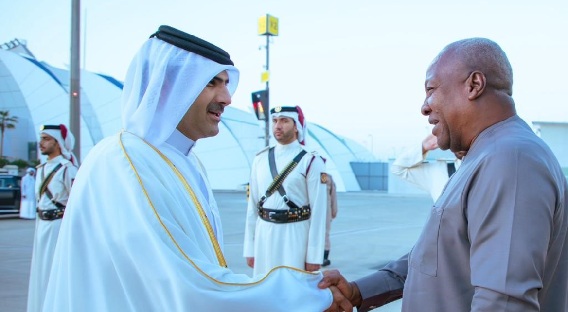


President John Dramani Mahama has commended the organisers of the 2025 Doha Forum for presenting this year’s awards to Alex Thier and Saad Mohseni.
The President said this was in recognition of the works, Alex Thier and Saad Mohseni were doing in closing educational learning gaps in two societies that were undergoing some of the worst crises known in recent history.
The awards were given during the opening ceremony of the Doha Forum 2025, by the Amir of Qatar, Sheikh Tamim bin Hamad Al Thani, on December 6.
The two were recognized for their “transformative” work in supporting children’s education in challenging environments, particularly Palestine and Afghanistan.
President Mahama gave the commendation in his address at the 2025 Doha Forum on the theme: “Justice in Action: Beyond Promises to Progress”.
Speaking on the topic “Education as Justice in Times of Crisis,” President Mahama said even in normal times, policymakers were always examining how to reform education to make it universally available and relevant in the context of a rapidly changing world.
He noted that the demand was even more urgent in societies that were affected by war and dislocation.
“The disruption of education affecting a current generation of children in Gaza, in Afghanistan, Sudan and elsewhere is an unfolding humanitarian tragedy that will play out for decades to come,” the President said.
He reiterated that Ghana’s own journey demonstrated that the most resilient nations were those that prioritised education even in the most challenging moments.
He said over the past decades, Ghanaians had pursued bold reforms to expand opportunity and strengthen justice through education.
“For example, our free basic and secondary education have enabled millions of Ghanaian youth to access education regardless of their family income,” he said.
The President said investments in Technical and Vocational Education and Training (TVETs) and digital literacy, strengthening early childhood and basic education.
He said a period when the world innovated for educational justice was during COVID-19.
“Schools were closed across the world and countries. Various countries had to innovate and implemented some of the most adaptive education in emergency times. Nationwide radio and TV learning programs were launched,” he said.
President Mahama noted that digital platforms for remote learning were deployed, community-based teaching and tutoring were provided and teachers were supported to innovate new methods to keep learning alive.
He said these measures were expression of justice, ensuring that no child was abandoned in a moment of global crisis.
He said the global experience during the COVID pandemic demonstrated that education systems could be built with resilience at their core.
The President underscored that when crisis hits, classrooms should not be the first to close and the last to reopen; declaring that they must remain anchors of hope, stability and protection.
He said the conversation of education as justice in times of crisis was relevant to Africa, where 30 million children remain out of school; stating that millions more were in school but not learning.
President Mahama said climate-related emergencies were displacing communities and shutting down schools, and that digital divides were widening socioeconomic gaps.
He said education was not the only focus of the Sustainable Development Goal Four (SDG 4), Quality Education, but also the enabler of all the other sustainable goals.
“Because without education, we cannot end poverty, which is SDG 1. Without education, we cannot achieve good health and well-being, which is SDG 3. Without education, we cannot attain gender equality, which is SDG 5,” he stated.
“Without education, we cannot build decent work and economic growth, which is SDG 8. Without education, we cannot strengthen climate adaptation, which is SDG 13. And without education, we cannot secure peace, justice and strong institutions, which is SDG 16.”
He said education illuminates the path to every other goal and that it empowers individuals, strengthens institutions and transforms nations.
“If we want a just, peaceful and prosperous world, we must start by ensuring just, equitable and resilient education systems.”
The President said the theme of the 2025 Doha Forum reminds the world that justice was not confined to domestic laws.
“It is a global concern. Education is a global public good, and when children in one region are denied the opportunity to learn due to conflict or poverty, the entire world loses talent, innovation and potential.”
GNA