
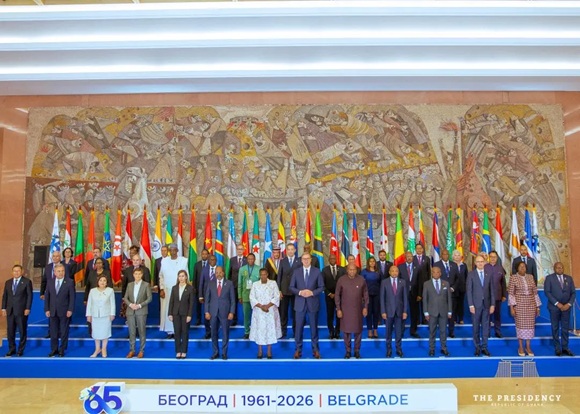


President John Dramani Mahama has called for a renewed and more action-oriented Non-Aligned Movement (NAM), urging member states to translate the movement’s founding principles into practical action to promote peace, sovereignty, development and global justice.
Addressing the 65th anniversary commemoration of the Non-Aligned Movement in Belgrade, Serbia, President Mahama said the principles that brought the movement together in 1961 remain relevant in today’s increasingly fragmented and multipolar world.

He recalled Ghana’s historic role in the formation of the movement, noting that Ghana’s first President, Dr. Kwame Nkrumah, was among the foremost leaders who gave political expression to the Non-Aligned Movement at the historic Belgrade Conference.
Dr. Nkrumah joined President Josip Broz Tito of Yugoslavia, Prime Minister Jawaharlal Nehru of India, President Gamal Abdel Nasser of Egypt and President Sukarno of Indonesia in championing the sovereignty and independence of newly emerging nations at the height of the Cold War.
President Mahama said Ghana’s position was clearly articulated by Dr. Nkrumah, in his famous declaration: “We neither face east or west, we face forward.”
He said the statement reflected Ghana’s determination to pursue an independent foreign policy, maintain constructive relations with all countries, and resist being drawn into competing geopolitical power blocs.
According to President Mahama, the world may have changed significantly since the Cold War, but developing countries continue to face pressures that threaten their strategic autonomy.
He identified renewed geopolitical competition, economic vulnerabilities, unequal access to finance and technology, climate change, and the under-representation of the Global South in international decision-making as some of the major challenges confronting developing nations.
President Mahama, therefore, called on the Non-Aligned Movement to remain an independent and collective voice for peace, dialogue, disarmament, development, and justice.
He stressed that non-alignment should not be interpreted as neutrality in the face of injustice, conflict, or violations of international law.
“We must neither be silent spectators of global developments nor instruments of competing geopolitical interests,” he said.
The President also called for stronger coordination among NAM member states, particularly within the United Nations and other multilateral institutions, arguing that the movement’s influence must be measured not only by its numbers but by its ability to achieve coordinated diplomatic outcomes.
Ghana’s Reparations Agenda

President Mahama also highlighted Ghana’s leadership in the global campaign for reparatory justice.
He cited the adoption of United Nations General Assembly Resolution A/RES/80/250 on March 25, 2026, which he said recognised the trafficking of enslaved Africans and the racialised system of chattel enslavement of Africans as the gravest crime against humanity.
The resolution received 123 votes in favour, following collaboration among the African Union, CARICOM and the African diaspora.
President Mahama expressed appreciation to fellow NAM members for their support, describing the outcome as evidence of the power of collective action.
He said Ghana, as the African Union Champion for Reparations, would continue to lead efforts to advance the global reparations agenda.
He recalled the Next Steps Conference on Reparatory Justice, hosted by Ghana in Accra in June, which expanded the conversation to include indentured labour as another historical injustice requiring attention.
The conference also established three key bodies: a High-Level Advisory Council on Reparatory Justice, a Global Experts Panel on Restitution of Cultural Heritage, and a Global Legal Panel on Reparatory Justice.
President Mahama said Ghana would use a side event at the 81st United Nations General Assembly in September to receive updates from the three bodies and invited fellow African leaders to participate.
Mahama Calls for Action on Global Conflicts
The President further called for greater international attention to conflicts and humanitarian crises, particularly in Sudan and Gaza.
He described Sudan as facing one of the world’s worst humanitarian crises, with millions displaced, widespread hunger, and grave violations against civilians.
He called for sustained political attention, humanitarian assistance, and a renewed commitment to peace in Sudan.
On Gaza, President Mahama said the humanitarian situation remained catastrophic, calling for the protection of civilians and full and unhindered humanitarian access.
He also reiterated Ghana’s opposition to the selective application of the principles of the United Nations Charter.
Call for Economic Independence
President Mahama said political independence must be matched by economic capacity, arguing that resource sovereignty should remain central to the development agenda of countries in the Global South.
He criticised a global economic structure in which developing countries largely export raw materials while importing finished goods, despite bearing much of the environmental and social costs of extraction.
He also urged NAM member states to strengthen cooperation on development financing, trade, climate change, debt, technology, and reform of the global financial architecture.
On climate change, President Mahama called for a united global response, citing droughts, desertification, floods, wildfires, and other extreme weather events as evidence of the growing threat.
He said the Non-Aligned Movement must adapt to emerging challenges, including artificial intelligence, digital inequality, and widening development gaps.
Quoting former Yugoslav President Josip Broz Tito at the inaugural NAM summit in Belgrade in 1961, President Mahama said developing countries could no longer remain mere observers in global affairs.
He said that principle remains relevant 65 years later.
President Mahama reaffirmed Ghana’s commitment to working with NAM members to strengthen multilateralism, advance a fairer international order, and ensure that the voice of the Global South carries greater weight in global decision-making.
He concluded with a call to renew the spirit of Belgrade and translate the collective strength of the Non-Aligned Movement into practical outcomes for its people.
“Neither East nor West, but forward together,” he said, urging member states to work collectively towards a more peaceful, just, and equitable international order.