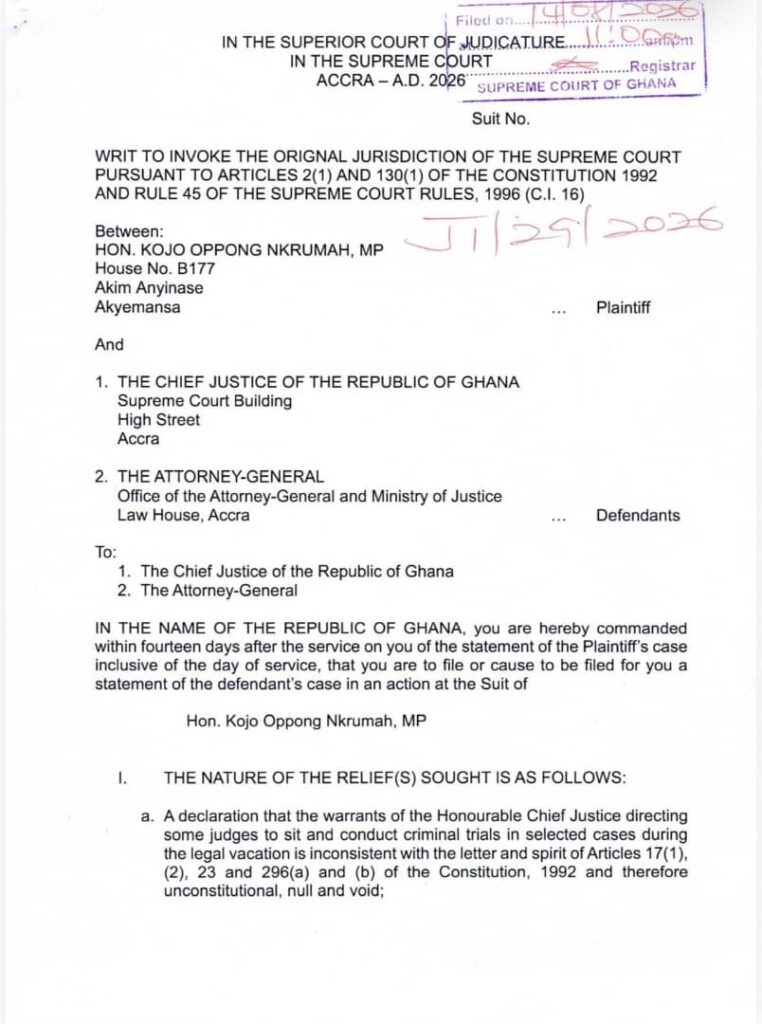



Member of Parliament for Ofoase-Ayirebi, Kojo Oppong Nkrumah, has invoked the original jurisdiction of the Supreme Court to challenge the Chief Justice’s decision to direct some judges to hear selected criminal cases during the legal vacation.
In a writ filed at the Supreme Court, Mr Oppong Nkrumah is seeking declarations that the warrants issued by the Chief Justice for judges to sit during the legal vacation are unconstitutional.
He argues that the directives are inconsistent with Articles 17(1) and (2), 23 and 296(a) and (b) of the 1992 Constitution.
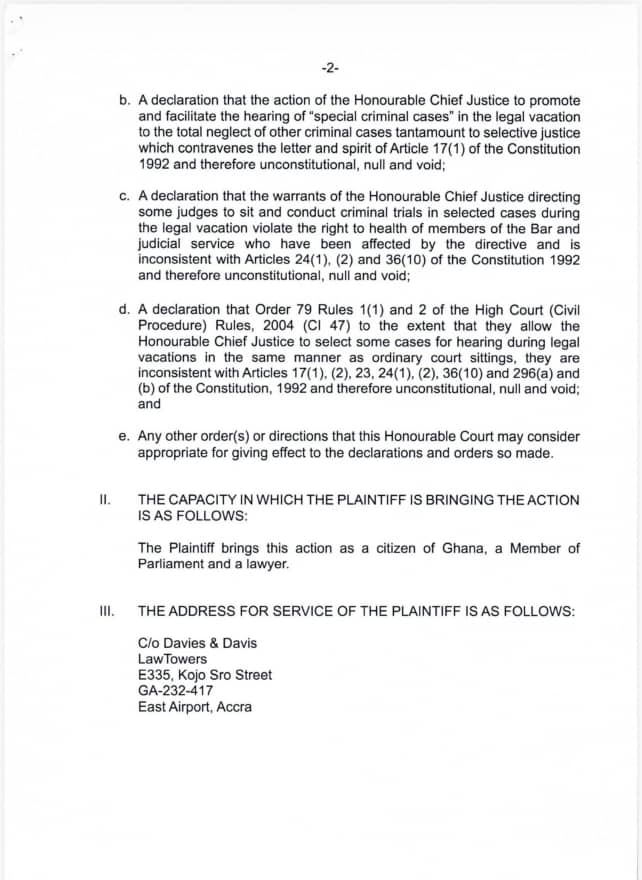
According to the MP, the decision to allow “special criminal cases” to be heard during the legal vacation, while other criminal cases are not given similar treatment, amounts to selective justice.
He is therefore asking the court to declare the directives unconstitutional, null and void.
Mr Oppong Nkrumah is also challenging the decision on health grounds, arguing that it violates the right to health of members of the Bar and Judicial Service affected by the directives.
He contends that the decision is inconsistent with Articles 24(1) and (2) and 36(10) of the Constitution.
The Ofoase-Ayirebi MP is further asking the Supreme Court to declare Order 79 Rules 1(1) and 2 of the High Court (Civil Procedure) Rules, 2004 (C.I. 47), unconstitutional to the extent that they allow the Chief Justice to select cases for hearing during legal vacations in the same manner as ordinary court sittings.
He is also seeking any other orders or directions the Supreme Court considers appropriate to give effect to the declarations sought.
The writ names the Chief Justice of Ghana and the Attorney-General as defendants.
Mr Oppong Nkrumah says he is bringing the action in his capacity as a Ghanaian citizen, Member of Parliament and lawyer.
The defendants have been directed to file their statements of case within 14 days after being served with the plaintiff’s statement of case.
The defendants have been directed to file their statements of case within 14 days after being served with the plaintiff’s statement of case.