
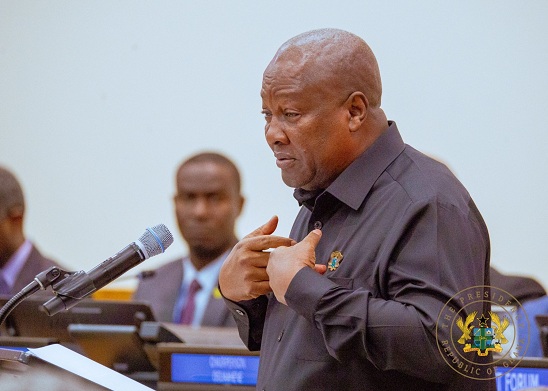


President John Dramani Mahama has called on United Nations (UN) member states to vote in favour of a landmark resolution formally declaring the transatlantic slave trade the gravest crime against humanity.
The President made the appeal on Tuesday while delivering the keynote address at the UN High-Level Special Event on Reparatory Justice at UN Headquarters in New York, a gathering he convened as part of Ghana’s push to table the resolution at the General Assembly the following day.
The President stated that the resolution was not merely a historical acknowledgement but a safeguard against the forgetting that was already taking place.
“This resolution allows us, as a global community, to collectively bear witness to the plight of the 18 million men, women, and children whose homes, communities, names, families, hopes, dreams, futures, and lives were stolen from them over the course of four centuries,” President Mahama added.
He urged delegates not to look away from the full weight of what that number represented.
He opened his address with a declaration that set the tone for everything that followed.
“There is no such thing as a slave. There were human beings who were trafficked and then enslaved by people who believed they could own those human beings as chattel, as their personal property,” he told the gathering, arguing that the distinction was not a matter of splitting hairs but one of acknowledging basic human dignity.
The President said the resolution was a pathway to healing and reparative justice, and that its adoption would serve as a collective act of bearing witness to a crime the world had too long refused to name properly.
“This resolution is a pathway to healing and reparative justice. This resolution is a safeguard against forgetting,” he said.
To illustrate the scale of what the resolution sought to acknowledge, President Mahama put human figures to the trafficking routes.
He told delegates that roughly six million enslaved Africans were trafficked to Brazil, almost two million to Jamaica, about 500,000 to America, and over 450,000 to Barbados.
“Remember when you hear these numbers that this is not data, these are human beings,” he said.
President Mahama also used the address to warn that the forgetting the resolution was designed to prevent was already underway.
He pointed to a 2015 US geography textbook used in over 1,000 school districts in Texas that described enslaved Africans as “workers” rather than enslaved people. He also cited the removal of Black history courses from school curricula across the United States, the banning of books on slavery and racism in schools and public libraries, and animated educational videos used in classrooms across 11 American states that he said were normalising the erasure of the true history of slavery.
“These policies are becoming a template for other governments as well as some private institutions,” he warned.
He told the gathering he was speaking not only for Ghana but in solidarity with the rest of Africa, the Caribbean, Latin America, the wider diaspora, and all people of good conscience throughout the world.
President Mahama closed his address by invoking Nelson Mandela, quoting the former South African leader’s words on human compassion and the shared capacity to turn common suffering into hope, before making a final direct appeal to those in the room.
“I hope all of you will vote tomorrow to speak truth to power so that together we can pass this historic resolution and finally acknowledge the full horror of these transgressions against the humanity of the 18 million human beings who were enslaved,” he said.