
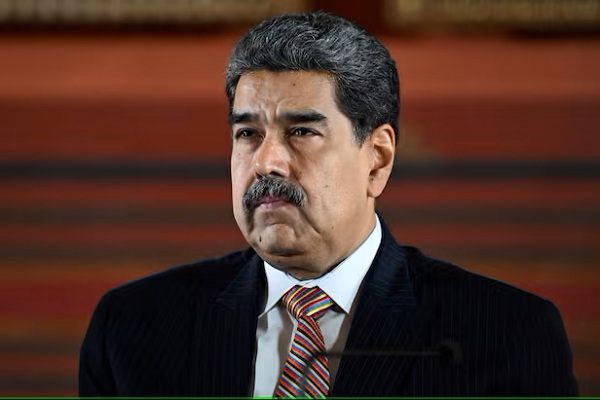


The US has attacked Venezuela and captured its President Nicolás Maduro, with Donald Trump vowing to "run the country" until there is a "proper" transition of power.
Venezuela's left-wing leader and his wife were captured at their compound and flown to the US, as part of a dramatic overnight special forces operation that also saw strikes on military bases.
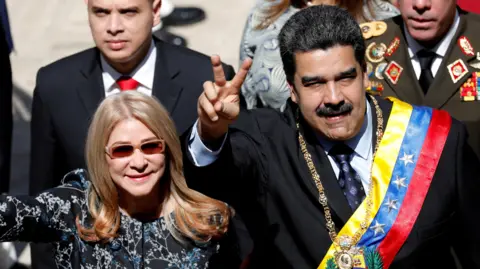
Maduro and First Lady Cilia Flores have since been charged with weapon and drug offences in New York.
Trump also promised US oil companies would move into the country and warned the US would stage a second attack if needed. Venezuela's Vice-President Delcy Rodríguez said the government was ready "to defend", while the attack has prompted international criticism.
Here is what we know so far.
What do we know about the operation?
The US military stormed Maduro's home at 02:01 local time (06:01 GMT). Trump said US forces were able to cut the power in the capital, Caracas, but it is unclear how they did this.
The US president said Maduro tried to enter a steel-fortified safe room and made it past the door, but was unable to close it.
Maduro was captured by the US army's Delta Force, the military's top counter-terrorism unit, after a CIA source in Venezuelan government helped the US track his location.
Trump added that no US forces were killed and there were "few" injuries. More than 150 aircraft were used to get the extraction team into the capital.
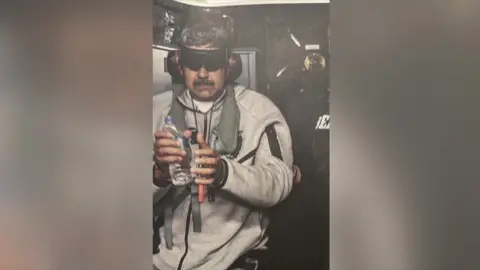
Maduro and his wife were taken on board the USS Iwo Jima and then a plane, which later landed at Stewart Air National Guard Base in New York state.
The pair were then transported to Metropolitan Detention Center, a federal facility in Brooklyn.
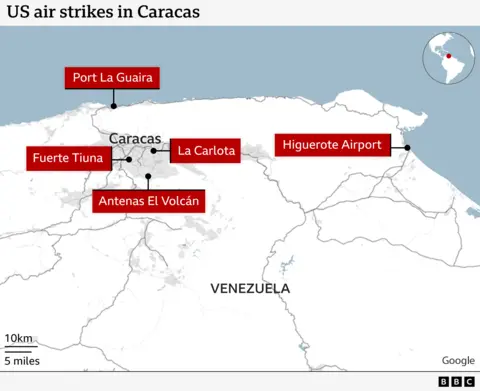
US officials have indicated that air strikes around Caracas were used as cover for the extraction operation.
BBC Verify has confirmed five locations that were targeted:
- Generalissimo Francisco de Miranda Air Base, an airfield known as La Carlota
- Fuerte Tiuna, a key military facility in Caracas
- Port La Guaira, Caracas' main conduit to the Caribbean Sea
- Higuerote Airport, just east of Caracas
- Antenas El Volcan, a telecomms towers
Who's now in charge in Venezuela?
Venezuela's Vice-President Delcy Rodríguez, who was part of Maduro's inner circle, is now the interim president after being sworn in by the nation's Supreme Court.
On Saturday, she demanded Maduro's release, saying he was the "only president".
Despite Trump's claims the US would run Venezuela until "a safe and proper and judicious transition" was possible, Maduro's allies remain in charge.
It is unclear exactly how the US plans to run Venezuela or who will be involved, but the US president said it would be a "group" effort.
He added that US Secretary of State Marco Rubio had been talking to Rodríguez, who had expressed her willingness to do "whatever the US asks".
This is at odds with Rodríguez's publicly refusing that Venezuela would become "a colony of an empire".
Trump also said he had not spoken to Venezuela's opposition leader María Corina Machado, who he characterised as having neither the support nor the respect within Venezuela to become its leader.
Machado had earlier called for Edmundo González to assume power. She had rallied support for González in the 2024 presidential election and vote tallies released by her party suggest he won by a landslide.
What next for Venezuela?
While US officials have indicated it was not planning any further military intervention in Venezuela, Trump said "we're not afraid of boots on the ground" in response to a question about deploying US troops there.
Trump also said US oil companies would move in to fix infrastructure "and start making money for the country".
He said "we're going to be taking a tremendous amount of wealth from the ground" which would go to people in Venezuela and to the US, adding "we're going to get reimbursed for everything we've spent".
He also said the US would sell oil to other countries.
Venezuela's government described the attack as an attempt to seize "Venezuela's strategic resources, particularly its oil and minerals" in an attempt to "forcibly break the political independence of the nation".
Venezuela holds the world's largest proven oil reserves, but it is so-called "heavy, sour" oil. This is harder to refine but useful for making diesel and asphalt, while the US typically produces "light, sweet" oil used to make petrol.
What has Maduro been charged with?
US attorney General Pam Bondi said Maduro and his wife were indicted in the Southern District of New York.
They have been charged with conspiracy to commit narco-terrorism and import cocaine, possession of machine guns and destructive devices, and conspiracy to possess machine guns and destructive devices against the US.
"They will soon face the full wrath of American justice on American soil in American courts," Bondi wrote on X.
 Donald Trump
Who is Maduro and why has he been captured?
Maduro rose to prominence under the leadership of left-wing President Hugo Chávez, succeeding him as president in 2013.
Maduro has been at odds with Trump over the arrival of hundreds of thousands of Venezuelan migrants in the US and the movement of drugs into the US, in particular fentanyl and cocaine.
But counter-narcotic experts say Venezuela mainly acts as a country through which drugs produced elsewhere are smuggled, while fentanyl is mainly produced in Mexico and typically enters the US via their shared land border.
Trump has designated two Venezuelan drug gangs, Tren de Aragua and Cartel de los Soles, as Foreign Terrorist Organisations (FTOs) and has alleged that the latter was led by Maduro himself.
Maduro has vehemently denied being a cartel leader and has accused the US of using its "war on drugs" as an excuse to try to depose him and get its hands on Venezuela's oil.
In recent months, US forces carried out more than two dozen strikes in international waters on boats they allege were used to traffick drugs, killing more than 100 people.
 Reuters
How has the world reacted?
The initial news of the strikes prompted the strongest reaction from Venezuela's long-term allies.
Russia accused the US of committing "an act of armed aggression" that was "deeply concerning and condemnable".
China's foreign ministry called on the US to release Maduro and his wife "at once" and to "stop toppling the government of Venezuela".
Iran's foreign ministry called the strikes a "flagrant violation of the country's national sovereignty".
Many Latin American countries, including Venezuela's neighbours, Colombia and Brazil, also condemned the actions.
Cuba's President Miguel Diaz-Canel described them as a "criminal attack", while Colombian President Gustavo Petro called the strikes an "assault on the sovereignty".
Meanwhile, Trump's ally in Argentina, Javier Milei, wrote "freedom moves forward" and "long live freedom" on social media.
On the international stage, UN Secretary General Antonio Guterres' spokesman said he was "deeply concerned that the rules of international law have not been respected".
UK Prime Minister Keir Starmer said his government would "shed no tears" about the end of Maduro's regime and would discuss the "evolving situation" in Venezuela with US counterparts.
The EU's top diplomat Kaja Kallas reiterated the bloc's position that Maduro lacks legitimacy and that there should be a peaceful transition of power, but said the principles of international law must be respected.
Spain's Prime Minister Pedro Sanchez said it did not recognise Maduro's regime but would neither recognise an intervention that "violates international law and pushes the region toward... uncertainty".