


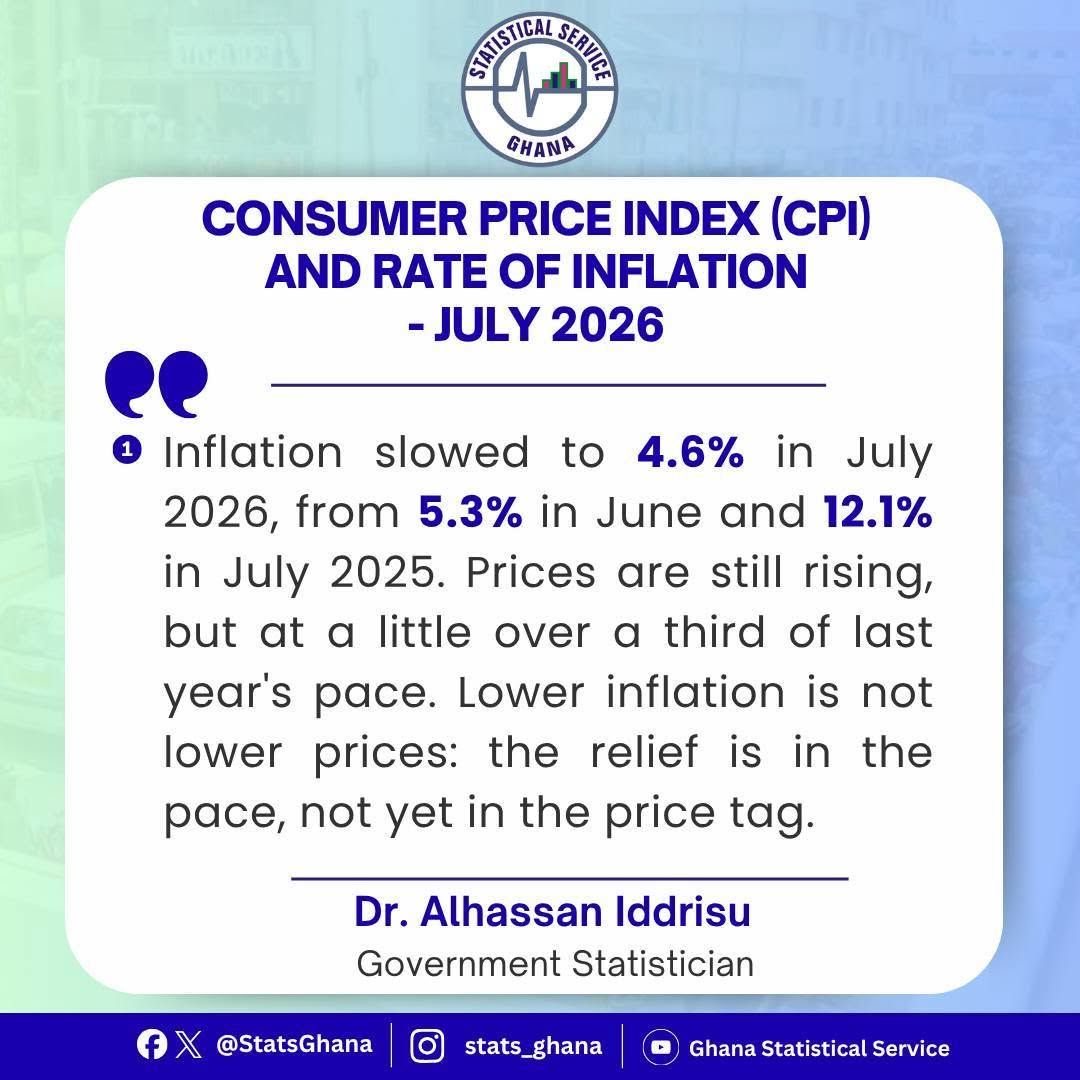
Ghana's inflation rate dropped to 4.6% in July 2026, down from 5.3% in June and 12.1% in July 2025, according to the Government Statistician, Dr Alhassan Iddrissu.
Announcing the latest Consumer Price Index (CPI) data on Thursday, Dr Iddrissu said the figures show that prices are still increasing, but at a much slower pace than a year ago.
"Lower inflation is not lower prices. The relief is in the pace, not yet in the price tag," he said.
On a month-on-month basis, prices increased by 0.1% between June and July, compared with 0.2% recorded in June, indicating that the rate of price increases has continued to slow.
Dr Iddrissu explained that while the year-on-year inflation rate compares prices with the same period last year, the month-on-month figure reflects what consumers actually experienced over the past four weeks.
He noted that services inflation stood at 8.5%, significantly higher than 3.4% recorded for goods, while non-food items accounted for 67.6% of July's overall inflation.
The housing, water, electricity and gas category recorded 8.3% inflation and contributed 22.8% to the overall inflation rate. Rent alone accounted for 13% of headline inflation, with school fees, transport fares and utility charges also contributing significantly to household costs.
The Government Statistician said locally produced goods recorded 5.9% inflation and accounted for 86.7% of July's inflation, while imported goods recorded 2.0% inflation, contributing 13.3%.
He said the latest figures suggest that domestic supply conditions, rather than exchange rate movements, were the main driver of inflation in July.