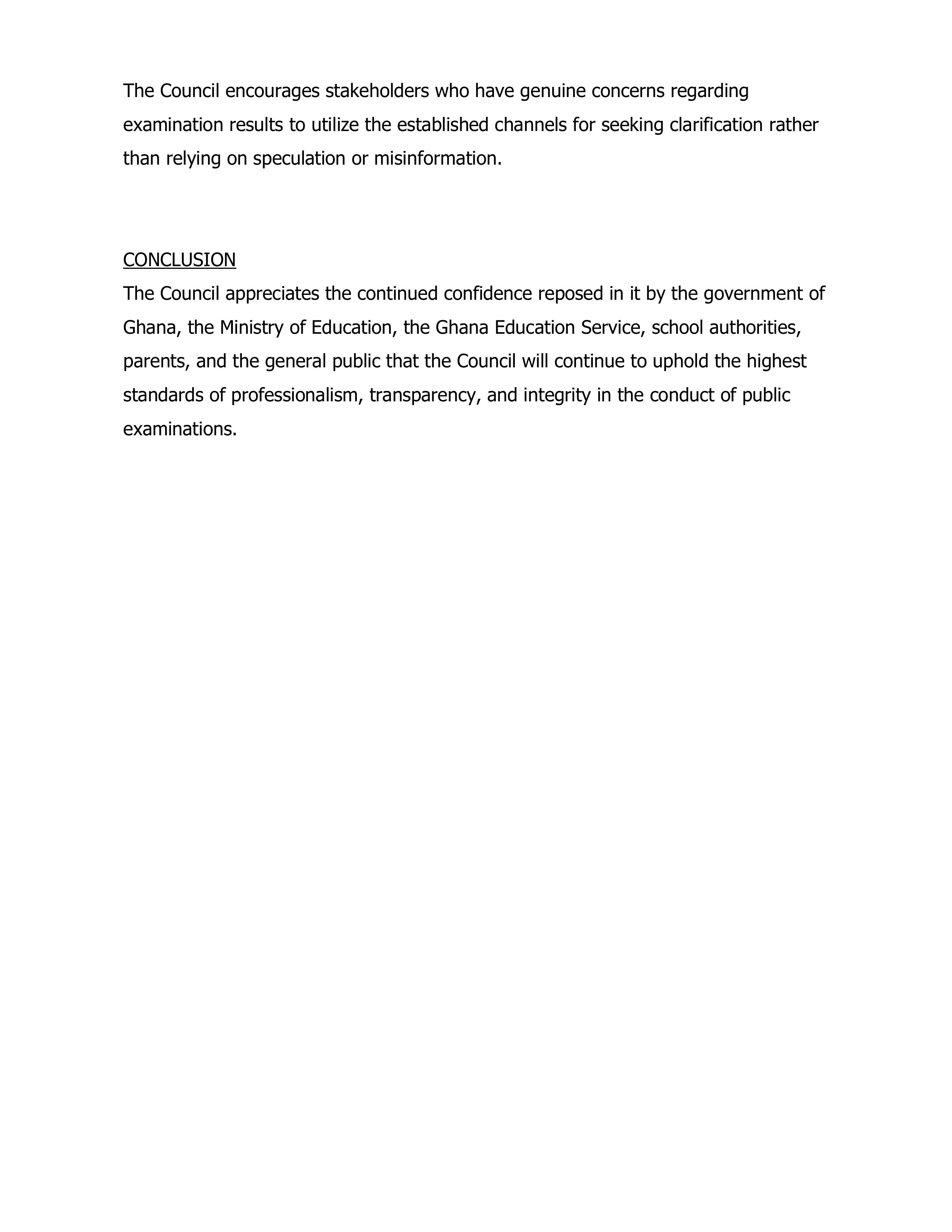



The West African Examinations Council (WAEC) has dismissed allegations that candidates from private schools who sat for the 2026 Basic Education Certificate Examination (BECE) for School Candidates were deliberately awarded poor grades.
In a press statement, the Council described the claims circulating on social media and in sections of the media as false, misleading and without any factual basis.
WAEC assured parents, guardians, school proprietors, educational authorities and the general public that its assessment and grading processes are guided by internationally accepted principles of fairness, objectivity, consistency and integrity.
The Council stressed that it does not discriminate against candidates based on whether they attend public or private schools.
Explaining its marking procedures, WAEC said it employs rigorous quality assurance measures to ensure fairness throughout the assessment process.
According to the Council, candidates’ scripts are anonymised by swapping them across regions, coding and packaging them before they are randomly assigned to examiners.
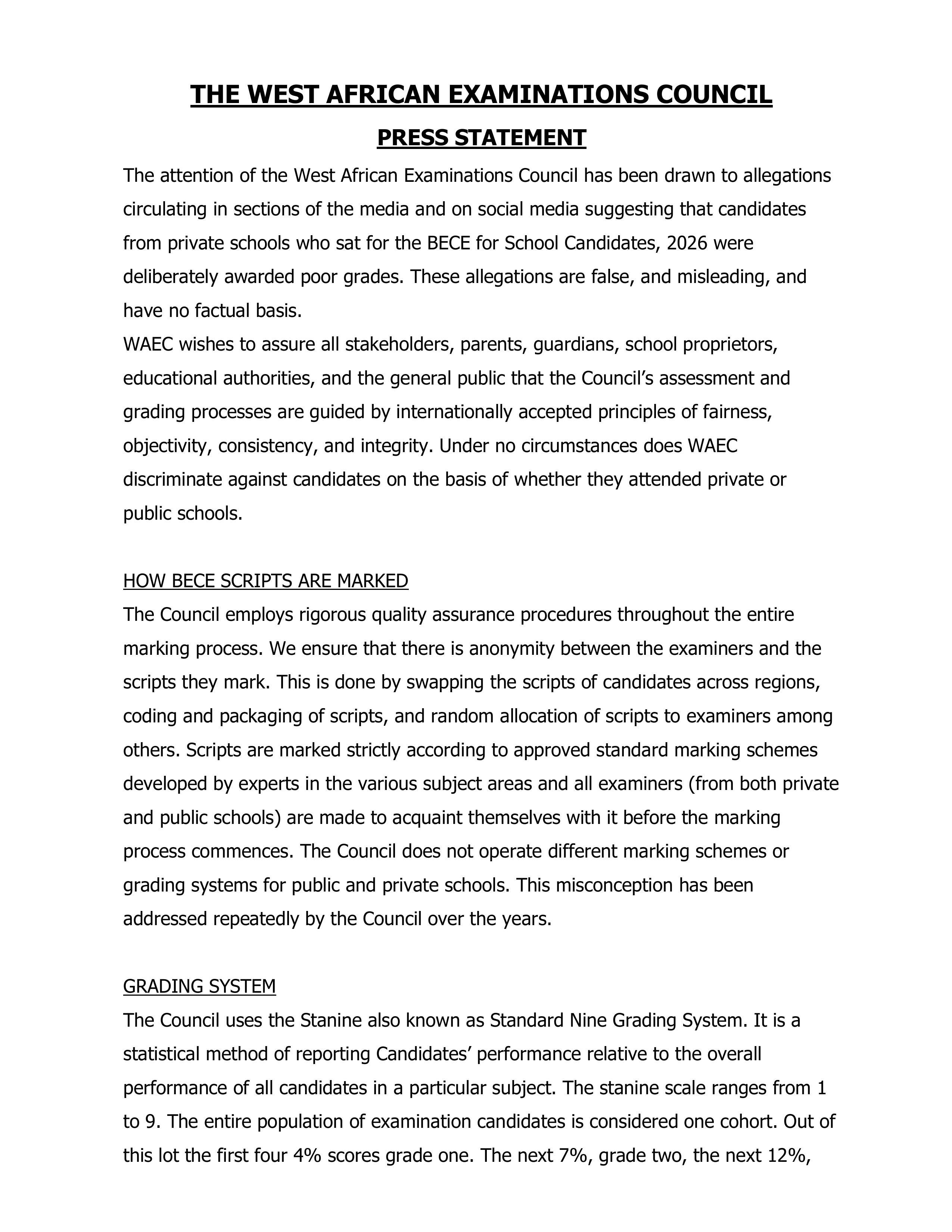
It added that all scripts are marked using approved marking schemes developed by subject experts, with examiners from both public and private schools undergoing training to ensure uniform application of the marking guidelines.
“The Council does not operate different marking schemes or grading systems for public and private schools,” the statement emphasised.
WAEC explained that it uses the Stanine, or Standard Nine, grading system, which ranks candidates based on their performance relative to all candidates who sat a particular subject.
Under the system, Grade One is awarded to the top four per cent of candidates, followed by Grade Two for the next 7%, Grade Three for the next 12%, Grade Four for the next 17 %, Grade Five for the next 20%, Grade Six for the following 17 %, Grade Seven for the next 12 %, Grade Eight for the next 7% and Grade Nine for the final 4%.
The Council explained that, unlike systems that assign grades based on fixed score ranges, the Stanine system considers the overall distribution of candidates’ performance in each subject.
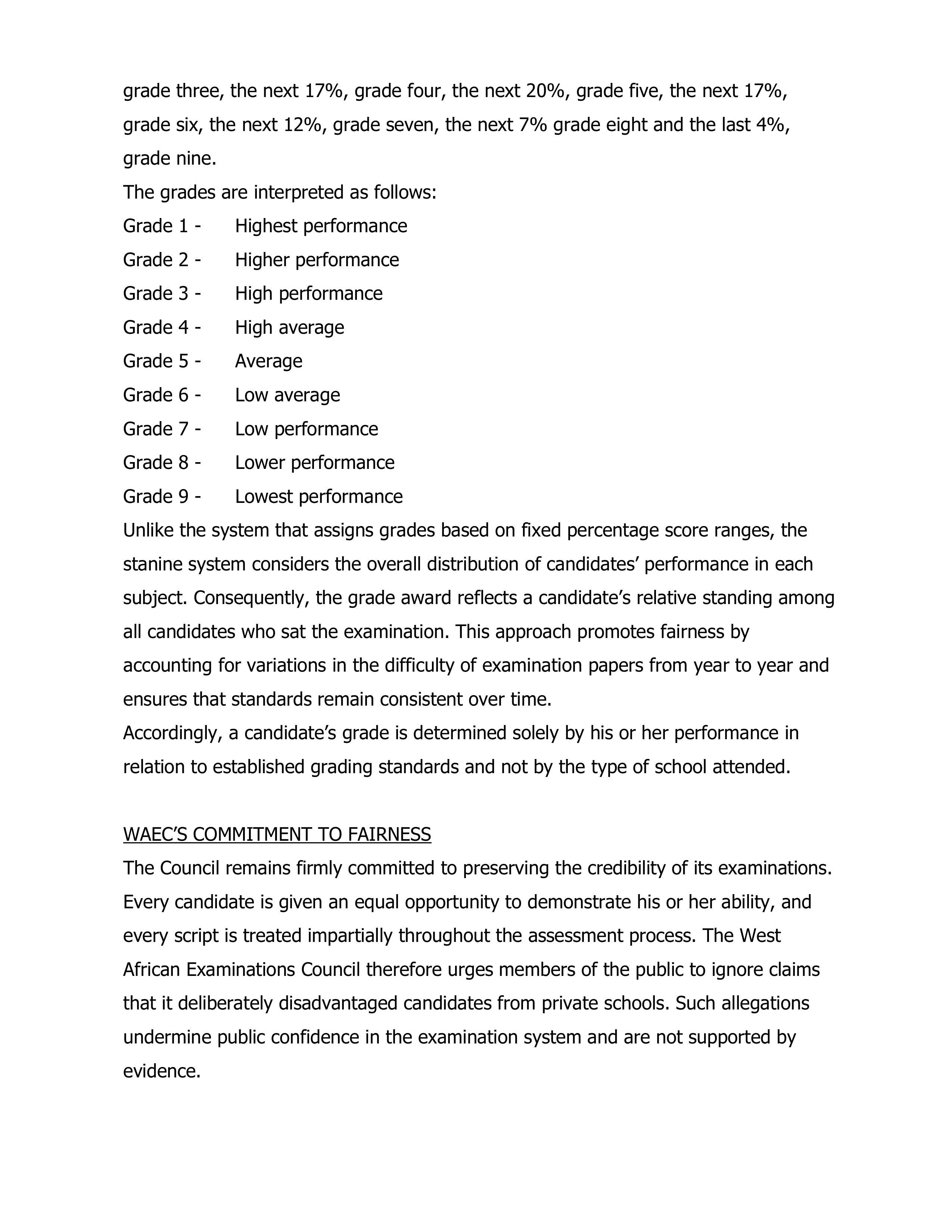
It said this approach accounts for differences in examination difficulty from year to year while maintaining consistent standards.
WAEC stressed that a candidate’s grade is determined solely by his or her performance relative to other candidates and not by the type of school attended.
The Council reiterated its commitment to maintaining the credibility and integrity of public examinations, assuring stakeholders that every candidate is given an equal opportunity and that all scripts are assessed impartially.
WAEC urged the public to disregard claims that it deliberately disadvantaged candidates from private schools, noting that such allegations undermine confidence in the examination system and are unsupported by evidence.
The Council also encouraged individuals with genuine concerns about examination results to use the established channels for seeking clarification rather than relying on speculation or misinformation.
It reaffirmed its commitment to upholding the highest standards of professionalism, transparency and integrity in the conduct of public examinations.