
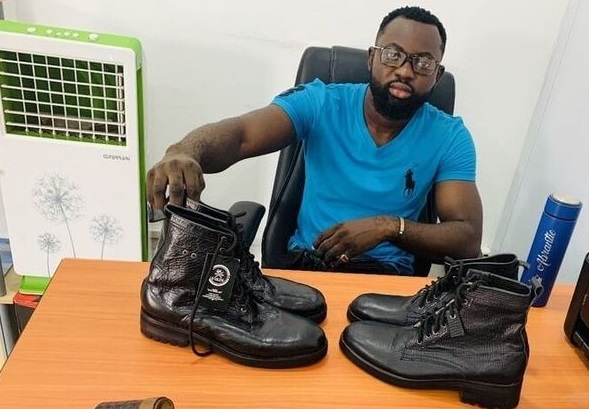


A young Ghanaian footwear manufacturer has shared an unfortunate tale to add his voice to the oft-cited lack of support startups face on their entrepreneurship journey.
The entrepreneur, who goes by the name ‘George Nkornyi’ on Facebook said even if your products or services are of international quality, the system wears you out and kills your entrepreneurship dreams.
“The system isn’t friendly to us,” George narrates in a post he made in response to the Finance Minister’s admonition to the youth to think of starting a business after graduation instead of joining the public service.
Ken Ofori-Atta explained that the public service was almost bursting at the seams and cannot take any new workers.
His comments drew mostly critical comments from a section of the public that thought he could have been a bit sensitive in his admonition since it was common knowledge that Ghana's bureaucratic and other bottlenecks stifle young businesses.
READ ALSO: It'll be madness to employ more public workers – Kwesi Pratt backs Ofori-Atta
While a small group of commentators thought the Minister had spoken the truth, the comment he made a graduation ceremony at the University of Professional Studies, Accra (UPSA) last month kickstarted a trend where entrepreneurs began sharing their harrowing tales on their startup journeys.
Most of the stories were accounts of business suffocation due to lack of support, a non-existent enabling financial regime, corruption, favouritism, among others that either killed their nascent business dreams, destroyed it mid-way or stagnated its progress.
According to George Nkornyi, he was told in the face by an unnamed police chief that although his leather boots were of high quality, he will not get the police to place an order for even a pair of boots.
“I managed to arrange a meeting with the quartermaster general of the Ghana Police service a week ago to present samples of my boots for his perusal and hopefully to get a piece of the contract to produce for the security service.
“Upon seeing the boots and testifying of [their] quality and durability, he bluntly said to me ‘we can’t help you nor work with you, the Ghana police service doesn’t buy their boots from Ghana.’
“I asked him: ‘Sir please can’t you give me [contract for] just a small quantity to produce for the new recruits?’”
“He said: ‘We can’t help you’. I sat down and wondered what the Ghanaian entrepreneur had done wrong to merit such rejection by its own leaders. How will the young Ghanaian entrepreneur thrive if measures, support and considerations are not in our favour. Will the American government reject its own citizen’s handiwork for another? I kept asking myself.”
More than 400 people rushed into his comments section to share a shorter tale of their own experience of discouragement of pain.
“They all have shares and on the pay rolls of suppliers. Quite, quite sad. The suppliers are all millionaires in their own right. Cartels and sharks in our country. They don't think beyond their own noses,” wrote Mary Agbettor.
This comment by Mary was consistent with 100 others that were of the view that a far-reaching network of corruption and underhand dealing within the public institutions is to blame for George’s ordeal.
Herman Chinery-Hesse, a respected IT guru in Ghana also blamed 'colonial mentality' for the penchant of persons in leadership to stifle the progress of Ghanaian change makers.
“I've been battling this colonial mentality for over 20yrs. One time I had to remind one of our leaders that there existed retired presidents from better-managed countries, who have a better track record in managing a country than our local politicians. I suggested we select and import one of those rather to run our country. Then he got it,” he also commented on George’s post.
Many more comments berated a cancerous system in Ghana that supports foreign-made goods and services – often cheaper and of low quality – at the expense of those of better quality by Ghanaian entrepreneurs.