
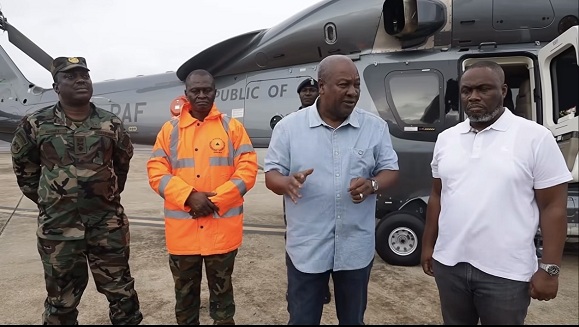


President John Dramani Mahama has commiserated with residents of Accra and Tema who lost homes, businesses and other property in Monday's flooding, describing the disaster as one of the worst the capital has experienced in recent years.
The President conveyed his sympathies following an aerial inspection of flood-affected areas, during which he observed firsthand the scale of destruction caused by heavy rains of approximately 140 millimetres across homes, businesses and public infrastructure in low-lying communities.
“I wish to express my deepest sympathy to all those who have lost property as a result of today’s floods. The damage has been extensive, and many families have been severely affected,” President Mahama said.
He said the volume of rainfall that fell on Sunday was among the highest recorded in a single day in Accra in several years, far exceeding the highest single-day total of about 56 millimetres recorded last year, and that the sheer scale of the water that descended on the city had overwhelmed drainage systems and waterways that were already under pressure.
To support affected families, the President instructed the Minister for Finance to release funds from the Contingency Fund for post-flood relief efforts and directed NADMO to identify victims across affected communities and begin providing immediate support in the coming days.
He commended the Ghana Armed Forces, NADMO, the Ghana Police Service, the Ministry of Works, Housing and Water Resources and the 48 Engineers Regiment for the speed and commitment of their emergency response, saying videos he had watched of rescue personnel carrying stranded residents to safety and deploying boats into flooded areas showed a dedication that had undoubtedly saved lives.
“I have watched several videos showing rescue personnel carrying stranded residents to safety and deploying boats to save lives. Their dedication has undoubtedly prevented an even greater tragedy,” President Mahama said.
Beyond expressing sympathy and announcing immediate relief measures, the President said the flooding demanded a response that went beyond comfort and assistance to address the root causes of a problem that had returned to devastate Accra year after year.
He said the National Security Council would convene urgently to address the matter, with every Metropolitan, Municipal and District Assembly directed to identify all obstructions along major drainage channels within their jurisdictions and earmark them for removal. Demolished structures would have their rubble cleared as well, ensuring that debris did not continue to block waterways after demolition.
President Mahama said both engineering and human factors were driving the flooding, pointing to the blocking of natural stream paths by buildings, illegal dumping in wetlands, and the sale of reclaimed wetland land for housing development as human-driven problems that government and citizens had to tackle together.
He said rainfall data from the Ghana Meteorological Agency showed that Accra had recorded about 85 millimetres of rainfall across June 2024, rising to 172 millimetres in June 2025 and jumping to approximately 333 millimetres in June 2026, a pattern he attributed to climate change that was making the city’s drainage challenge increasingly severe regardless of what else was done.
In the long term, President Mahama said government was planning to build a new city outside Accra to reduce the pressure that decades of rapid and poorly managed urbanisation had placed on the capital’s infrastructure, a 20-year project that would involve relocating major government institutions and developing new growth centres with roads, water and electricity.
He urged all Ghanaians to change their attitudes toward sanitation, waste disposal and construction in flood-prone areas, and warned that the time for repeating the cycle of alarm followed by inaction had passed.
“This time, we must act differently. Together, we must ensure that lasting solutions are implemented so that this cycle of devastating floods does not continue year after year,” President Mahama said.