
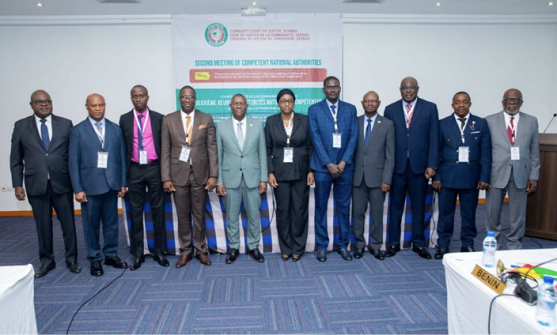


Justice Ricardo Cláudio Monteiro Gonçalves, the President of the Community Court of Justice, ECOWAS, has called on Member States to transform their commitment to enforcing the Court’s judgments into concrete action.
He noted that while significant progress has been made since the inaugural meeting of Competent National Authorities (CNAs) held in Lagos in 2025, the enforcement of Court judgments remained one of the most pressing challenges facing the regional judicial system.
Justice Ricardo Gonçalves made the call in a statement issued in Accra as the Second Meeting of CNAs opened in Cotonou, Republic of Benin.
The event was on the theme: “From Commitment to Framework: Operationalising a Collaborative Architecture for the Enforcement of Court Judgments.”
It brought together Competent National Authorities from Benin, Togo, Guinea, Senegal, Guinea Bissau, Liberia, Sierra Leone and Nigeria, representatives of the ECOWAS Commission and Parliament, senior officials of the Court, and other stakeholders involved in the enforcement of judicial decisions.
The President described the gathering as a critical step in strengthening the effectiveness of community justice across West Africa.
He said the credibility of the Court, the protection of human rights, and the success of regional integration depend largely on the effective implementation of judicial decisions by Member States.
He emphasised that every unenforced judgment represents delayed justice for citizens whose rights have been recognised by the Court.
He called for stronger cooperation among Member States, the ECOWAS Commission, the ECOWAS Parliament, and Competent National Authorities to address enforcement challenges.
“Every judgment that goes unenforced is a missed opportunity to strengthen the rule of law. Every delay undermines citizens’ trust. Every instance of noncompliance weakens the legal and institutional framework that our Member States have committed to building,” he said.
Justice Ricardo Gonçalves also urged Member States that are yet to designate their Competent National Authorities to do so without delay, noting that a fully functional enforcement system requires the active participation of all Member States.
Earlier, Dr. Yaouza Ouro-Sama, the Chief Registrar of the Court, outlined the objectives and expected outcomes of the meeting.
He said participants would deliberate on and adopt a Collaborative Framework for the Enforcement of ECOWAS Court Judgments, review progress made since the Lagos meeting, assess national enforcement efforts, and strengthen coordination among relevant ECOWAS institutions.
He said the meeting was expected to produce a harmonised enforcement framework, improved reporting mechanisms, enhanced cooperation among stakeholders, and a roadmap for accelerating compliance with Court judgments across the Community.
Mr. Gaye Sowe, the Director of Legal Affairs, speaking on behalf of the ECOWAS Commission, described the meeting as a timely initiative aimed at reinforcing the credibility of the ECOWAS legal order.
He reaffirmed the Commission’s commitment to working closely with the Court, Competent National Authorities, and the ECOWAS Parliament to strengthen follow-up mechanisms and support the implementation of Court decisions.
He noted that effective enforcement of judgments is essential to ensuring that the rights recognised by the Court translate into meaningful remedies for citizens and contribute to the rule of law, accountability, and regional integration.
Participants are expected to adopt a Collaborative Framework for the Enforcement of ECOWAS Court Judgments and a Final Communiqué outlining collective commitments, priority actions and a roadmap for strengthening compliance with the Court’s decisions across the region.
The Second Meeting of the Competent National Authorities forms part of the Court’s broader efforts to ensure that its judgments are not merely pronounced but effectively implemented, thereby reinforcing access to justice, strengthening public confidence in regional institutions, and advancing the rule of law across West Africa.
GNA