
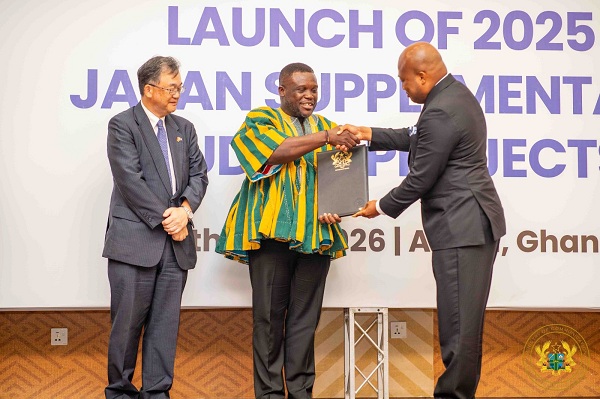


Ghana and Japan have jointly launched three major initiatives aimed at strengthening peacebuilding, advancing digital transformation, and enhancing health innovation.
The projects, unveiled on Wednesday, April 15, 2026, at the Ministry of Foreign Affairs, are funded through Japan’s Fiscal Year 2025 Supplementary Budget with an initial investment of approximately US$1.5 million. They are being implemented in collaboration with the United Nations Development Programme (UNDP) and the World Health Organisation (WHO).
The initiatives include a peacebuilding project in Bawku under the Humanitarian-Development-Peace (HDP) Nexus, a digital transformation programme focused on public sector capacity building, and an artificial intelligence-driven health project.
During the ceremony, the Minister for Foreign Affairs, Samuel Okudzeto Ablakwa, emphasised that these projects reflect a profound shared commitment to peace, inclusive development, and responsible innovation.
He further noted that the interventions are meticulously aligned with Ghana’s national priorities regarding conflict resolution, digital governance, and the pursuit of universal health coverage.
Addressing the specific challenges in the north, the Minister highlighted the Bawku initiative as a vital complement to ongoing national efforts. He described the project as part of a coordinated approach that integrates reconciliation and reconstruction with the cultivation of long-term community resilience.
Supporting this perspective on the security dimension, National Security Advisor Prosper Bani stressed that sustainable peace requires more than mere security enforcement; it necessitates a focus on dialogue, trust-building, and inclusive development to resolve underlying grievances.
The digital landscape of the partnership was detailed by the Minister for Communication, Digital Technology and Innovations, Samuel Nartey George, who underscored the transformative potential of AI in modern governance. He revealed that Ghana’s National Artificial Intelligence Strategy has officially received Cabinet approval and is scheduled for launch next week, a move intended to position the country as a regional leader in the ethical deployment of AI.
The Japanese Ambassador to Ghana, Hiroshi Yoshimoto, characterised this partnership as a testament to the deepening bilateral relations between the two nations.
He reaffirmed Japan’s dedication to supporting Ghana through interventions that prioritise human security.
In a statement delivered on behalf of the Minister for Health, Kwabena Mintah Akandoh, it was noted that the AI-for-health project would significantly bolster disease surveillance, enable the early detection of outbreaks, and enhance data governance to broaden healthcare access.
International partners also expressed their confidence in the tripartite collaboration. UNDP Resident Representative Niloy Banerjee commended Japan’s consistent support, noting that these projects demonstrate how innovation and peacebuilding can be pursued in tandem.
Similarly, WHO Country Representative Fiona Braka stressed the necessity of ensuring that healthcare AI remains ethical and people-centred, while the UN Resident Coordinator, Zia Choudhury, affirmed that the initiatives contribute directly to the Sustainable Development Goals.