
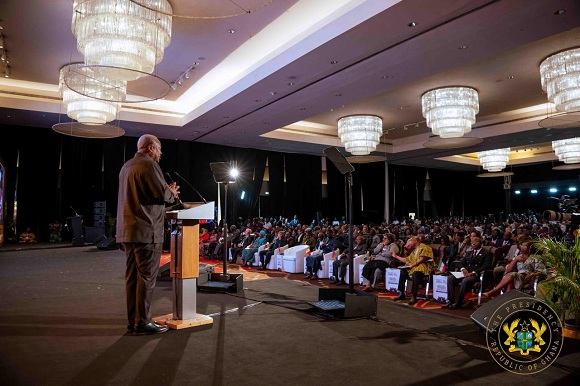


President John Dramani Mahama has called on world leaders, institutions and civil society to build a practical international roadmap that moves the reparatory justice agenda from declaration into sustained and coordinated action.
The President made the call on Wednesday at the opening of the Next Steps High Level Consultative Conference, convened less than three months after the United Nations General Assembly adopted Resolution A/RES 80/250, which recognised the transatlantic slave trade as a crime against humanity following a campaign Ghana launched at the UN General Assembly in September 2025.
President Mahama said the roadmap the conference needed to produce must go well beyond exchanging views or producing an outcome document, covering truth-telling, research and education, memorialisation, the restitution of cultural heritage, legal pathways and the creation of meaningful partnerships between Africa, the diaspora and the wider international community.
“Our objective over the next few days is not simply to exchange views. It is intended to lay the foundations for a practical international roadmap,” he said.
He told the conference that recognition created responsibility and that the enduring consequences of the history of enslavement continued to demand thoughtful, coordinated and sustained international engagement, making the work of translating the resolution into action both urgent and necessary.
President Mahama said the work could not be accomplished through declarations alone or through a single conference, and called for stronger collaboration among governments and partners, greater alignment among existing initiatives and clear pathways to advance the aspirations outlined in the resolution.
He announced the establishment of three global panels to anchor the next phase of the effort, covering strategic guidance on reparatory justice, the restitution of cultural artefacts, and legal approaches consistent with international law and human dignity.
The President told participants that senior officials and technical experts had already developed a draft framework to guide discussions at the conference and inform collective efforts going forward, describing their work as an important contribution to the task at hand.
He said the African diaspora was indispensable to the process, describing descendants of those who endured enslavement not as observers but as right holders whose experiences, knowledge and aspirations must shape the path ahead.
President Mahama drew attention to Ghana’s particular place in the history the conference sought to address, noting that Elmina, Cape Coast, Assin Manso and Osu held some of the most visible physical reminders of a system that uprooted millions of Africans and altered the course of world history.
“Not too far from where we are gathered today stand castles, dungeons, and the doors of no return through which countless Africans passed before disappearing over the horizon,” he said.
He told the conference that future generations would judge its participants not by the resolutions adopted but by the progress achieved, and urged those gathered in Accra to choose truth over denial, partnership over indifference and justice over delay.
“Let them say that when history called upon our generation to act, we stood up and we answered with courage,” President Mahama said.