
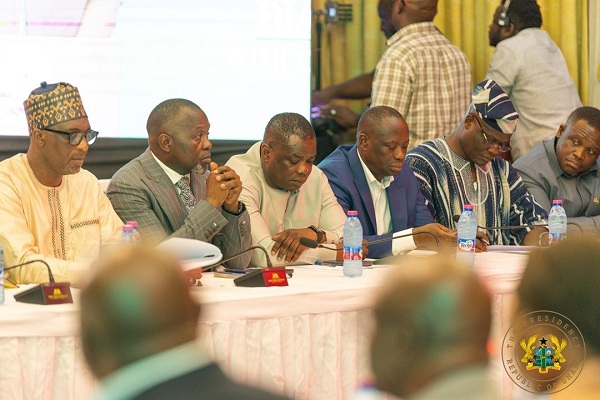


President John Dramani Mahama has directed the Ministry of Roads and Highways to formally respond to allegations contained in a Fourth Estate investigation into procurement practices under the Big Push infrastructure programme.
President Mahama announced this on Monday at a presidential dialogue with civil society organisations at the Presidency, where he addressed the exposé directly and used it as a springboard to announce a broader overhaul of how Ghana handles public procurement.
He said the ministry had been instructed to obtain the full detailed report from the Fourth Estate beyond the snippets that had appeared in the media and conduct a thorough study of the allegations before the government determined its course of action.
The Ministry of Roads and Highways, he said, had simultaneously been asked to put together a detailed response to the specific allegations made in the report.
President Mahama acknowledged that single sourcing was legal under certain circumstances within Ghana’s current procurement framework, but said open and competitive tenders were always the preferable route for delivering value for money on public projects.
The investigation, he said, had made clear that the law needed tightening.
He also mentioned plans to amend Ghana’s Public Procurement Act to restrict single sourcing across government.
“Government will introduce amendments to the Public Procurement Act to limit single sourcing in order to promote greater transparency and ensure proper value for the money we spend on projects,” he told the gathering.
Alongside the legislative amendment, President Mahama said he had directed the Ministry of Finance to fast-track the establishment of an Independent Value for Money Office.
Once in place, he said, the office would subject all single source procurements to rigorous value for money reviews, adding an institutional check that currently did not exist.
He noted that he would consult with civil society on the new procurement legislation before it was finalised, describing the organisations in the room as natural partners in the effort to strengthen transparency in public spending.