
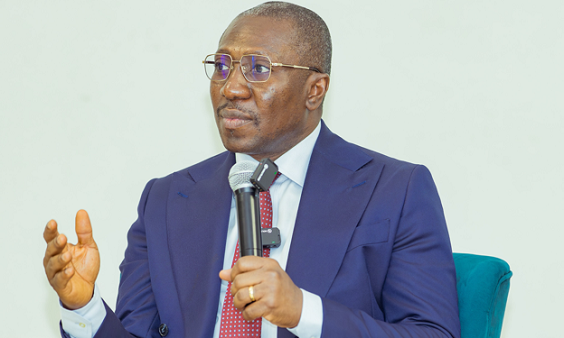


Minority Leader Alexander Afenyo-Markin has positioned Dr. Mahamudu Bawumia as the candidate best placed to advance the ideals of the Danquah-Dombo-Busia tradition in a rapidly evolving technological and economic landscape.
Delivering a lecture at the Young Commons Forum (YCF), organised by students of the Kwame Nkrumah University of Science and Technology (KNUST) and Kumasi Technical University, Afenyo-Markin argued that Bawumia has successfully adapted the movement’s core principles of individual liberty, private enterprise, and opportunity to address Ghana’s contemporary challenges.
“Every tradition that survives across generations must answer the same question each time leadership passes to a new hand: does this successor carry the inheritance forward, or only invoke its name?” Afenyo-Markin said.
“The case I wish to make is that Dr. Mahamudu Bawumia has done the harder thing.”
Political Journey
The Effutu Member of Parliament traced Bawumia’s political roots to the very foundations of the Danquah-Dombo-Busia tradition. He noted that Bawumia’s father, Alhaji Mumuni Bawumia, was a founding figure of the Northern People’s Party and served as its vice chairman alongside Chief S.D. Dombo.
This family legacy, Afenyo-Markin said, firmly places Bawumia within a distinguished political lineage stretching back to Ghana’s pre-independence era. He added that Bawumia’s vision for the country is anchored on inclusivity, economic transformation, and technological advancement.
The Minority Leader emphasised that Bawumia seeks to build a nation that harnesses the talents of all citizens — irrespective of ethnicity, political affiliation, or religion — while creating sustainable jobs and positioning Ghana to thrive in the Fourth Industrial Revolution.
Key Pillars
Afenyo-Markin outlined the key pillars of Bawumia’s vision, including macroeconomic stability, fiscal discipline, private-sector-led growth, tax simplification, digital transformation, lower living costs, value addition to natural resources, and stronger accountability mechanisms.
He explained that the programme aims to sustain low inflation, stable exchange rates, and prudent government spending, while reducing the size of government and encouraging greater private sector participation in infrastructure development.
The Minority Leader also spotlighted Bawumia’s strong emphasis on digitalisation, noting that technology, artificial intelligence, and data-driven systems would be central to modernising public services, agriculture, healthcare, and education. He further highlighted proposals to reduce the cost of living through targeted investments in housing, transportation, food production, and renewable energy.
“Big Tent” Approach
Afenyo-Markin argued that these policies are not a departure from the Danquah-Dombo-Busia tradition but a contemporary expression of its enduring philosophy.
“It would be a mistake to receive this vision as something new grafted onto an old party,” he said. “It is, rather, a modern expression of a philosophy that has been constant since Saltpond in 1947.”
He noted that Bawumia’s “big tent” approach mirrors the inclusive coalition-building that defined the formation of the United Party in the 1950s, uniting diverse ethnic, regional, and religious groups under a shared vision.
The remarks form part of the NPP’s broader effort to present Bawumia as both a faithful custodian of the party’s historical traditions and a forward-looking leader equipped to tackle Ghana’s emerging economic and technological challenges.
Defence of NPP’s Social Record
Afenyo-Markin mounted a robust defence of the New Patriotic Party’s social intervention record, asserting that many of Ghana’s most transformative policies were introduced by governments rooted in the Danquah-Dombo-Busia tradition.
Kufuor’s Legacy
The Effutu lawmaker credited former President John Agyekum Kufuor with replacing the controversial “cash and carry” healthcare system with the National Health Insurance Scheme (NHIS).
“Before Kufuor came to office, we had what we call cash and carry,” Afenyo-Markin said. “The NDC says they are social democrats, but under the NDC we had what we called cash and carry.”
He described the NHIS as a landmark reform that reduced financial barriers to healthcare and enhanced citizens’ productive capacity. The scheme, he said, reflects a centre-right philosophy that treats social protection as a means of empowering individuals to participate more effectively in the economy, rather than fostering dependency.
Afenyo-Markin also pointed to the introduction of the Capitation Grant, the Free Compulsory Universal Basic Education programme, and the School Feeding Programme under Kufuor’s administration, which significantly expanded access to education and eased the burden on low-income families.
“It was Kufuor’s administration that for the first time in the history of our country under the Fourth Republic declared and made basic education free,” he said.
He further credited Kufuor with establishing the Metro Mass Transit system, demonstrating that centre-right governments recognise the importance of strategic public investment.
Akufo-Addo’s Achievements
Turning to the administration of former President Nana Akufo-Addo, Afenyo-Markin described the Free Senior High School (Free SHS) policy as one of the most consequential social interventions in Ghana’s Fourth Republic.
He argued that the policy has widened educational opportunities for students from disadvantaged backgrounds and remains consistent with the Danquah-Dombo-Busia tradition’s focus on human capital development.
“Free SHS therefore represents not a departure from centre-right philosophy, but its practical fulfilment,” he said.
The lawmaker also praised the expansion of free Technical and Vocational Education and Training (TVET), the One-District-One-Factory (1D1F) initiative, Planting for Food and Jobs (PFJ), and the Agenda 111 hospital project.
He described 1D1F as a decentralised approach to industrial development and job creation, PFJ as an effort to make agriculture commercially viable for smallholder farmers, and Agenda 111 as a major step towards bridging healthcare access gaps in underserved communities.
Contrast with NDC
Afenyo-Markin drew a sharp contrast between the NPP and the National Democratic Congress (NDC).
“I contend therefore that the NDC has no single social intervention programme introduced by them and implemented successfully since they first had a chance to govern this country,” he told the audience.