
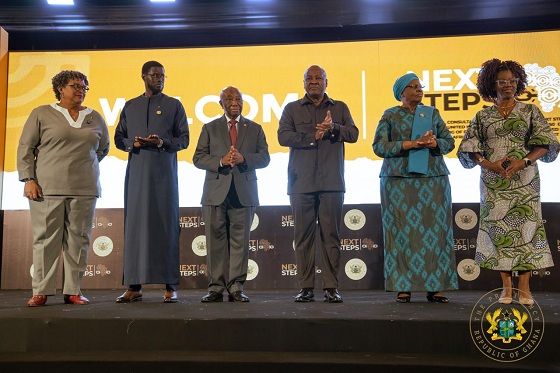


President John Dramani Mahama has called for reparatory justice frameworks to be explicitly gender-responsive.
He bemoaned that specific experiences of enslaved women and girls have been systematically marginalised in the historical record and must be placed at the centre of truth-telling, remembrance and redress.
The President made the call at the Next Steps High Level Consultative Conference in Accra, where world leaders, scholars, jurists and civil society representatives gathered to chart the path forward following the United Nations General Assembly’s adoption of Resolution A/RES 80/250, which recognised the transatlantic slave trade as a crime against humanity.
President Mahama said while millions of African men, women and children suffered the violence and indignity of the transatlantic slave trade, the experiences of women and girls were marked by distinct and compounding forms of brutality that history had repeatedly failed to record or acknowledge.
“History remembers the names of the ships, the merchants, and the trading companies. Yet far too often it forgets the woman whose body became a site of exploitation, or the mother standing on the shore, uncertain whether she would ever see her child again,” he said.
He said for many enslaved women, exploitation extended far beyond forced labour, with their bodies transformed into instruments of economic extraction and their capacity to bear children turned into a mechanism for reproducing bondage across generations.
Their suffering, he said, was often deliberately concealed from official records, making them victims not only of the institution of slavery but of historical erasure.
President Mahama paid tribute to women whose courage had sustained the long struggle for freedom, naming Nanny of the Maroons in Jamaica, whose story is believed to have begun on the shores of present-day Ghana, alongside Harriet Tubman and Sojourner Truth as examples of women who stood at the forefront of resistance against oppression.
He said countless others whose names history had failed to record had nevertheless preserved families, communities and hope under the most extreme circumstances, and that their contribution deserved acknowledgement at the highest level.
The President also recognised women present at the conference itself, including scholars, activists, jurists, public servants, policymakers and civil society leaders who continued to advance the cause of reparatory justice.
“Any framework for truth-telling, memorialization, reparatory justice, or historical reckoning that fails to recognise the specific experience of women will remain incomplete,” President Mahama said.
He called on all participants at the conference to ensure that women’s historical experiences moved from the margins to the centre of the international reparatory justice agenda, saying the global narrative on slavery would remain distorted for as long as it continued to treat the suffering of women and girls as secondary.
“Their stories remind us that reparatory justice must also be gender responsive. The historical experiences of women and girls cannot remain footnotes in the global narrative. They must occupy their rightful place at the centre of truth-telling, remembrance, and redress,” he said.