



Urging Iranians to overthrow their clerical rulers, the US launched "major combat operations" along with Israel against Iran early on Saturday.
The US is calling the operation "Epic Fury", while the Israelis call it "Lion's Roar".
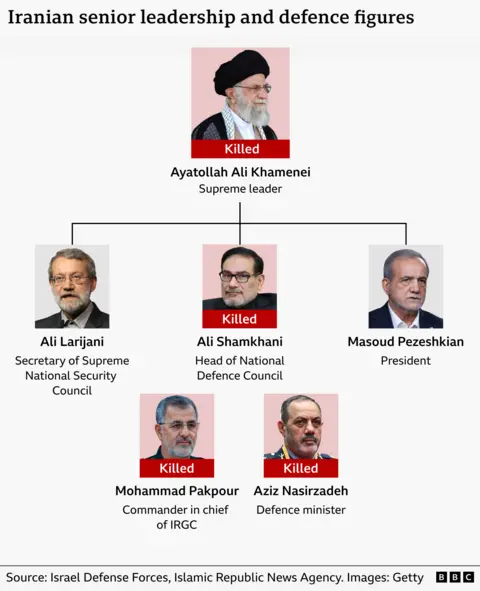
Iran's Supreme Leader Ali Khamenei and other senior officials have been killed.
The aerial assault came two days after US-Iranian talks on Tehran's nuclear programme ended without a deal.
Iran launched counter-attacks throughout the Middle East in retaliation to what its foreign minister called an "unprovoked, illegal" attack by the US and Israel.
Here's what we know so far:
How many have died?
Three US service members have been killed in action and five seriously injured, US Central Command said on Sunday, without identifying the deceased.
The personnel were based in Kuwait, reports the BBC's US partner CBS.
"Several others sustained minor shrapnel injuries and concussions - and are in the process of being returned to duty," Central Command posted on X.
More than 200 people have been killed across Iran and more than 700 injured, according to the Red Crescent on Saturday.
At least 165 people including children have died in an explosion at a school in southern Iran, according to Irna, the state news agency.
At least nine people died when an Iranian missile hit a synagogue bomb shelter in the central Israeli town of Beit Shemesh, the BBC's Hugo Bachega reports from the scene.
One person died and at least 20 were wounded when an Iranian missile hit several buildings in central Tel Aviv, according to Israeli newspaper Haaretz.
In counterattacks, Iran also fired drones and missiles at Bahrain, Kuwait and Qatar the UAE, all of which have a US military presence.
One person was killed and 11 injured at airports in Abu Dhabi and Dubai, authorities and airport officials said.
Did Trump need Congress' approval to attack Iran?
In his video announcement, Trump described the US-Israel attacks on Iran as "major combat operations".
Congress reserves the power to officially declare war, as written in Article I of the US Constitution, but it has not done so.
The Constitution does, however, give the president broad authority to engage in military action.
This grey area has been the source of much debate recently in Washington.
Reactions on Capitol Hill to the US-Israel attack on Iran have fallen largely along partisan lines. Republicans, who currently control both chambers of Congress, were mostly in support.
House Speaker Mike Johnson, a Republican, said the Trump administration had notified the "Gang of 8" - a bipartisan group of congressional leaders - ahead of the strikes.
Democrats mostly denounced the attacks, accusing Trump of launching a war without congressional approval.
Democrats renewed calls for Congress to take up a war powers resolution, like the bill that failed last year for lack of Republican support.
If another war powers resolution were introduced and passed, it could block the president's unilateral use of force without congressional approval.
But the odds of such a bill passing appear unlikely for now.
Few Republicans have indicated they would back such a measure, except for congressman Thomas Massie and Senator Rand Paul.
Why did the US attack Iran?
Shortly after explosions were reported in the Iranian capital on Saturday, Trump took to social media to accuse Tehran of waging an "unending campaign of bloodshed and mass murder targeting the United States".
He argued Iran had rejected every opportunity to renounce its nuclear programme and claimed it was developing long-range missiles that could threaten Europe, US troops overseas, and even "soon reach the American homeland".
He further cited the violent takeover of the US embassy in Tehran in 1979, resulting in dozens of Americans being held hostage for 444 days, as well as Iran's proxies bombing a US Marine barracks in Beirut in 1983 that killed 241.
The US president had also pledged in January to intervene when Iranian security forces crushed protests amid an economic crisis.
In June last year, the US bombed three nuclear facilities in Iran. Trump said the US Operation Midnight Hammer had "obliterated" Iran's nuclear programme.
Last summer's US attacks paved the way for a ceasefire in a 12-day conflict between Iran and Israel.
Israel had launched air strikes on Iranian nuclear, military and infrastructure sites. Tehran had retaliated by firing hundreds of rockets and drones at Israel.
How many of Iran's leaders have been killed?
Trump announced on social media that Supreme Leader Ayatollah Ali Khamenei had died, describing him as "one of the most evil people in History".
Iranian state TV later confirmed the death of Khamenei, 86, who had ruled since 1989, and declared 40 days of mourning.
Trump told Fox News that 48 Iranian leaders had been killed in the operation.
BBC Verify obtained satellite imagery taken over Tehran that showed significant damage to part of Khamenei's office in the Iranian capital.
Will there be US boots on the ground?
There's no indication US combat troops will be deployed on the ground in Iran, not least because of the low appetite among the American public for a ground invasion.
"The president has no plan for any kind of large-scale ground force inside of Iran," Republican Senator Tom Cotton told the BBC's US partner CBS on Sunday.
The US operation will include "an extended air and naval campaign", Cotton said, and search-and-rescue efforts could "go in and extract any downed pilot".
The US has about 13 military bases across the Middle East, with 30,000 to 40,000 troops normally deployed between them.
The US military has been building its presence in the Middle East for weeks and has two aircraft carriers, USS Gerald R Ford and USS Abraham Lincoln, in the region.
Does Iran have the capability to attack the US?
The Iranian regime has always denied it wants a nuclear weapon, but it has enriched uranium to a level that has no civilian use in a nuclear power programme, says the BBC's international editor Jeremy Bowen.
So far Israel and the US have published no evidence that it was about to build the bomb, he adds.
There have been no public reports of a pending Iranian attack on the US mainland, but local authorities from New York City to Los Angeles said they were on high alert.
BBC