
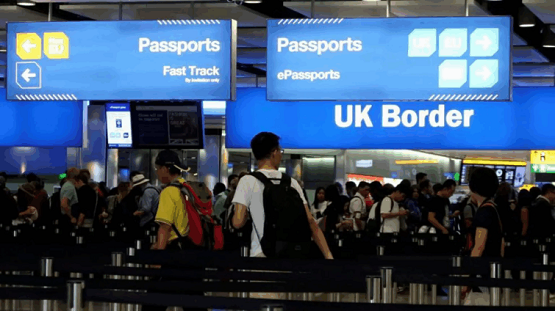


When Jelena returns home from a "holiday of a lifetime" travelling around South America later this year, she faces being told she can no longer enter the UK.
The British-Latvian dual national is among those who say they have been caught out by upcoming changes to passport rules for dual nationals, which are due to kick in on 25 February.
Entry requirements for dual nationals are being overhauled as part of sweeping changes to the immigration system, the government says, will streamline and modernise the UK border.
But for Jelena, who has lived in the UK for 16 years, the changes are a "betrayal", and others in the same situation have told BBC News the prospect of being denied entry is causing anger and concern.
Here are how the new rules will work - and why Jelena and others like her are furious about it.
How are passport rules for British dual nationals changing?
Under the existing rules, a British dual national whose other nationality is in a country not subject to UK visa requirements could travel to the UK using their foreign passport.
But from 25 February, that will no longer be the case.
Instead, they will need to show either a British passport or a new digital version of the certificate of entitlement to attach to their second nationality passport - and without one of them, they could face being denied the right to travel back to the UK.
Neither British passports or certificates of entitlement are automatically issued to people who obtain citizenship, which means some dual nationals have never applied for them, even if they have lived in the UK for decades.
Both documents take several weeks to obtain, and there are costs, too. A British passport costs around £100 for an adult, while the certificate of entitlement costs £589.
These new rules for dual nationals are linked to the rollout of the Electronic Travel Authorisation (ETA) system this month, a major immigration reform which will require visitors to the UK who do not have a visa to apply for a £16 entry document before arriving.
The government said it plans to increase the ETA fee to £20 in the future.
Dual nationals cannot apply for an ETA and must instead meet the new documentation requirements, with checks now carried out by airlines when departing for the UK.
The new rules do not apply to Irish passport holders, but other EU citizens will be affected.
According to the 2021 census, 1.2% of UK-born residents were UK-other dual citizens (587,600), and 6.5% of non-UK-born residents were UK-other dual citizens (648,700).
The government has said the reforms bring the UK's immigration system into line with countries like the US and Australia.
But critics say the looming deadline and a lack of communication around the changes have left people scrambling to apply for new documents, with dual nationals who are out of the country on holiday or visiting family facing the prospect of being stranded until they can acquire a passport or the certificate.
How are people being impacted by the new rules?
Jelena, who was born in Latvia and has lived in the UK ever since coming to study, became a British citizen in November.
The 34-year-old chartered surveyor told BBC News she delayed applying for a British passport when she became a citizen as she was travelling to see family for Christmas, so could not send off her Latvian passport as part of the application process.
Jelena only learned of the changes recently and is unable to apply for new documentation immediately as she is due to go on a long-planned trip to South America in a few weeks and may not get her passport back in time to travel.
"As it stands, after South America, I won't be able to return to my flat [in Glasgow], which my husband and I own, in the country I have lived in for nearly 16 years, studied in and paid taxes," she told BBC Your Voice.
Jelena intends to change her travel plans by returning to Latvia after her trip to apply for a British passport from there, potentially facing a wait of several weeks or months for it to arrive.
"I'm lucky that my employer is flexible about me working from abroad - if that wasn't the case, I wouldn't have a job because of this," she said.
"If I hadn't applied for citizenship and just had an EU passport, I would be in a better situation than I am now," she added.
"The irony is that I've chosen to be part of this country, but it feels like I'm being deported. It feels like a betrayal."
'I found out about it on Facebook'
Petra Gartzen, a UK-German dual national who has lived in the UK for four decades, said she was furious at the lack of communication about the upcoming changes and is frantically trying to obtain a Spanish passport, as she is staying there for a few months over the winter.
She told BBC News: "They changed the rules when I was already in Spain. There was no lead-up, no major announcement - I found out about it from a Facebook post, and just thought, now what?"
The government says publicly available information has been in circulation about the upcoming changes since October 2024, but critics say it has not cut through to people affected.
Petra, a tech industry analyst, was told she would need to travel from southern Spain to Madrid for an appointment to apply for the "ridiculously expensive" certificate of entitlement while outside the UK, further increasing the cost.
Petra has now applied for a UK passport from Spain, but that has had its own complications. "They agreed to accept a notarised copy of my German passport so I did not have to send that off, but they also wanted my original citizenship certificate - which I don't have, it's in the UK," she explained.
Petra now has a "nervous wait" to see whether the documentation she provided is accepted and processed in time for early March, when she is due to travel back to the UK before heading to the US for work.
She said she felt let down by the way the changes have been introduced, adding: "I've been a British citizen since 2019. The UK is my home - I've lived there for 40 years, I own a home, I work and pay tax. My whole life is there."
Swiss dual national Shaun West said he was considering not replacing his British passport and renouncing his British citizenship due to the new requirements.
"There's no worth in it for me," said the university professor, who became a Swiss citizen after Brexit.
He said he would rather pay the ETA fee to temporarily enter the UK to see his parents, adding: "[The government] said I'll lose consular services. I'm not bothered. [They said] you won't be able to live here. I'm not going to."
West said he learned about the rule change "utterly by accident" while reading online about how it affected Canadians, and that he believed it was discriminatory against dual nationals.

Norwegian dual national Linn Kathenes, who lives in the UK, said she was only notified by the Home Office about the new rules last week.
The teacher said that the changes mean she is now in a race against time to make arrangements for an upcoming overseas school trip.
Kathenes explained that she is waiting to collect her Norwegian passport, which she had to renew. She needs to send over the document before she can begin the process of getting the UK passport required to travel.
"I don't see another way, I just have to gamble", she said.
The Home Office has been contacted about her case.
Campaign group the3million, which represents EU citizens in the UK, has also criticised the government's communication about the changes.
"The Home Office has not done enough to warn dual nationals of the serious impact this will have on them," the group's head of policy and advocacy, Monique Hawkins, said.
She has called on the government to "urgently hit the pause button" and introduce a "low-cost, one-off travel authorisation" for dual nationals whose travel plans have been disrupted.
A Home Office spokesperson said: "Public information advising dual nationals to carry the correct documentation has been available since October 2024, and a substantive communications campaign about the introduction of ETA has been running since 2023.
"This requirement applies to all British citizens regardless of other nationality and is the same approach taken by other countries, including the United States, Canada and Australia."
BBC