
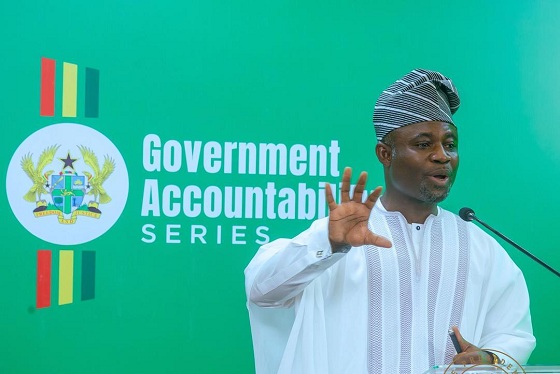


The Free Primary Health Care policy will be rolled out in phases between 2026 and 2028, beginning with 150 selected districts, particularly those that are underserved, before expanding to cover the entire country.
The Minister of Health, Kwabena Mintah Akandoh, disclosed this on Monday during a press engagement as part of the Free Primary Health Care Policy Accountability Series in Accra.
He said the phased approach is a deliberate decision to ensure quality and sustainability are maintained throughout the process.
“This phased approach allows us to learn, adjust, and ensure that quality and sustainability are maintained,” the minister said.
Over the next two months, Ghanaians in the first phase districts will begin to see the policy in action.
The government will distribute equipment to all 150 districts in the first phase, intensify community sensitisation through town halls, deploy trained volunteers to support the community health workforce, and establish over 350 container-based service delivery points in high-traffic areas such as markets and lorry parks.
The minister said groundwork had already been laid ahead of the policy’s launch. Service delivery points have been mapped, referral systems defined, and 24,534 pieces of essential medical equipment have been procured and are ready for deployment.
The equipment includes incubators for neonatal care, glucometers for diabetes screening, hospital beds, and ultrasound machines to support maternal health services.
The policy guarantees every Ghanaian access to a defined package of essential primary health care services free of charge at CHPS compounds, health centres and polyclinics, with the only requirement being a valid National ID.
Mr Akandoh said the policy also marked a fundamental shift in how the health system operates, moving away from a treatment-focused model toward one built around prevention, early detection and community engagement.
Health workers and volunteers, he said, would not only be waiting at facilities but would be visiting homes, schools, churches and workplaces to screen, educate and support communities to stay healthy.
He acknowledged the challenges the policy was designed to address, noting that Ghana’s Universal Health Coverage service index currently stands at about 56 percent, against a target of 80 percent by 2030.
Out-of-pocket payments, the minister said, still account for roughly one-third of total health expenditure, meaning many families face financial barriers before they can receive care.
“When people have to pay, they delay. They wait. They try to manage symptoms at home. And by the time they come to the facility, the condition has often worsened,” the minister said.
The full nationwide rollout is expected to be completed by 2028.