
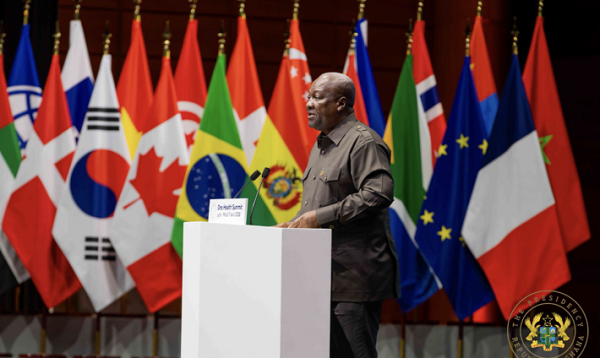


President John Mahama has called for global action to tackle rising health threats, outlining three key steps for world leaders while warning of deepening links between climate change, disease, and inequality.
In his address at the One Health Summit 2026 in Lyon, President Mahama, who is the Founder and driving force behind the Accra Reset Initiative, said the time had come to move beyond rhetoric and deliver real outcomes.
“The period of declarations must come to an end. The moment for coordinated effort is here, and let us start from Lyon,” he said.
He said the first step must be a shift from commitment to action, insisting that global leaders must prioritise implementation over pledges.
President Mahama added that One Health strategies must be embedded into national development agendas and aligned with a broader global public health framework.
“Let us connect our One Health strategies for our national development agendas to a new global framework for public health,” he urged, adding that international security systems must also adopt the approach.
On his third call, the President stressed the need for prevention through strong surveillance systems.
“Let us concentrate on building a new preventive shield and an intelligent radar system at its source,” he said, explaining that early warning mechanisms at the community level remain the strongest defence against future pandemics.
He added that such systems must be “smart, dynamic, agile, and interoperable” to ensure efficiency and avoid unnecessary bureaucracy.
Beyond the calls to action, the President cautioned that the world was facing an unprecedented convergence of health threats affecting humans, animals and plants.
“Around the world, we are facing an overwhelming surge of health threats across borders. Every species is in the crosshairs, animals, humans and plants,” he stated.
He linked these challenges directly to climate change, saying it was the underlying force intensifying global risks.
“At the foundation of all these crises is the phenomenon of climate change; everything is interconnected,” he said, pointing to the links between infectious diseases, antimicrobial resistance and disruptions to food systems.
Drawing from Ghana’s experience, President Mahama said diseases and pests were affecting smallholder cocoa farmers, while illegal mining continued to degrade forests and pollute water bodies.
“Illegal gold mining leads to forest degradation and pollution of our water bodies, threatening the survival of precious populations of birds and insects,” he noted.
He also raised concerns about plastic pollution, warning that it was damaging ecosystems globally.
“Plastic pollution is poisoning all our ecosystems. We must advance international action in dealing with plastic pollution,” he stated.
On global inequality, the President described the current situation as unacceptable.
“The countries that are most at risk have the least resources to cope with. This must change,” he stressed, calling for fair access to financing, technology, data and innovation.
He added that a stronger Africa would benefit the entire world.
“A healthy and thriving Africa is no threat to anyone. It will be a positive force for global progress,” he said.
President Mahama also made a case for prevention-led health systems, describing them as more efficient and sustainable.
“Prevention is not only more effective, but also much more cost-effective than cure,” he stated, pointing to Ghana’s rollout of the Ghana Medical Trust Fund and primary healthcare programmes.
He argued that Africa’s traditional knowledge systems already embodied the One Health concept.
“In Africa, our lived experience leads us to accept without question that human survival, animal well-being, and environmental care form a single interconnected system,” he said.
Referencing past outbreaks, including COVID-19, Mpox, Lassa fever and Marburg, Mahama said the world has yet to fully adapt.
“Each crisis has highlighted the importance of the One Health approach,” he noted, adding that global systems remain slow to respond.
President Mahama urged leaders to show stronger political will in addressing fragmented systems.
“Let Lyon be the turning point,” he said.
President Mahama said decisions taken at the summit would have far-reaching consequences.
“The decisions we make at this summit will shape the future of global health security… let us ensure that they result in tangible, measurable outcomes for our people and our planet,” he stated.
The summit, hosted by France under its G7 Presidency, has brought together global leaders and experts to advance coordinated action on the interconnected health of humans, animals and ecosystems.
GNA