
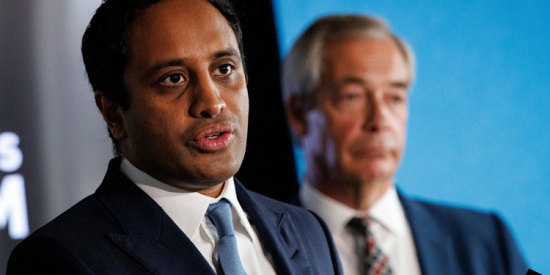


Reform UK has announced that it would stop issuing visas to countries that demand slavery reparations from Britain.
Seventeen nations have demanded billions of pounds to compensate for Britain’s historical role in the transatlantic slave trade.
Over the past two decades, Britain has issued 3.8 million visas to nationals of these countries and provided them with £6.6bn in foreign aid.
Zia Yusuf, Reform’s home affairs spokesman, said the UK had made “huge sacrifices” to end the slave trade, and described calls for British taxpayers to pay compensation as “insulting”.
Sir Keir Starmer has ruled out paying reparations, saying last year that he wanted to focus on the future rather than “spend a lot of time on the past”.
However, Mr Yusuf said Reform, which has already pledged to scrap foreign aid for countries demanding reparations, would go further.
He said: “A growing number of countries are demanding reparations from Britain. These countries ignore the fact that Britain made huge sacrifices to be the first major power to outlaw slavery and enforce this prohibition.
“Astonishingly, of the countries demanding reparations, Tory and Labour governments issued 3.8 million visas to their nationals and sent them a staggering £6.6bn in foreign aid over the last two decades. Enough is enough.”
Millions were enslaved in the British Empire following the creation of colonies in the Caribbean and the east coast of North America in the 17th century.
Following a massive public campaign led by William Wilberforce, Parliament abolished the buying and selling of slaves within the Empire in 1807, and in 1833 outlawed slavery entirely. The Royal Navy enforced the ban across the globe, seizing hundreds of ships.
A report published in 2023 by the University of West Indies, backed by Patrick Robinson, a judge who sat on the International Court of Justice, concluded that the UK owed more than £18tn in reparations for its role in slavery in 14 Caribbean countries – a sum almost seven times the size of the British economy.
So far, 11 countries in the Caribbean have demanded reparations from Britain – Antigua and Barbuda, the Bahamas, Barbados, Dominica, Grenada, Haiti, Jamaica, St. Kitts and Nevis, St. Lucia, St. Vincent and Grenadines, and Trinidad and Tobago. Caricom, the intergovernmental organisation of Caribbean states, has also made demands.
They have been joined by the African countries of Ghana, Kenya and Nigeria, along with Belize in Central America and Guyana and Suriname in South America. Montserrat, a British dependency in the Caribbean, has also lobbied for reparations.
Under Reform’s proposed crackdown, nationals from these countries would be blocked from obtaining work or study visas to come to the UK. The ban would also include visas for temporary visitors and visas for those who come to stay with a family member.
Out of the 17 countries listed, the country to have been granted the most visas since 2005 is Nigeria, with 2.7 million. The next most have gone to Ghana and Kenya. In the Caribbean, the highest number of visas have been granted to Jamaica (162,290) and Trinidad and Tobago (24,305).
Most of the nations are members of the Commonwealth, with the secretary general, Ghana’s Shirley Botchwey, also speaking out in support.
Several nations used the Commonwealth Heads of Government Meeting in Samoa in 2024 to lobby the King to support their demands as the institution’s head.
The King has described the slave trade as one of the most “painful aspects of our past” but has not issued a formal apology, despite being lobbied by Commonwealth leaders.
He is unable to do so without the support of the Government and, similarly, cannot pledge reparations.
Last month the United Nations General Assembly voted to declare the transatlantic slave trade as the “gravest crime against humanity”, and urged countries to consider an apology or to contribute to a reparations fund.
The resolution, proposed by Ghana, urged countries to consider apologising for the slave trade and to contribute to a reparations fund. The proposal was adopted with 123 votes in favour and three (the US, Israel and Argentina) against. The UK was among 52 countries that abstained.
Rachel Reeves has said the UK cannot afford to pay the huge sums demanded. Speaking to the BBC, she said: “I understand why they make those demands but that’s not something that this Government will be doing.”
However, Labour’s position is at odds with others on the Left. Members of the party’s Socialist Campaign Group have pushed for the UK to pay reparations. The Greens are also in favour.
Kemi Badenoch, the leader of the Conservative Party, has described arguments for reparations as a “scam”.
A Reform spokesman said: “A Reform government will not allow Britain to be slapped around and ridiculed on the world stage like the Tories and Labour. We will not allow British taxpayers to be insulted and their money wasted.”
The Telegraph