
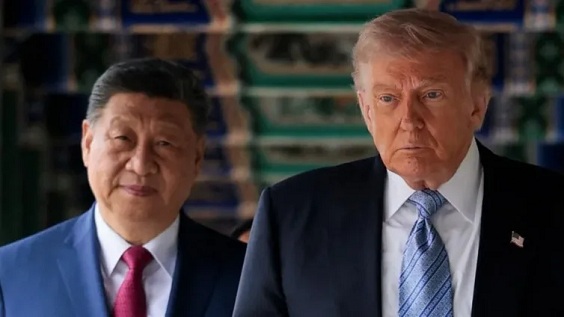


US President Donald Trump has cautioned Taiwan against formally declaring independence from China.
"I'm not looking to have somebody go independent," the US president told Fox News on Friday, at the end of his two-day summit with his Chinese counterpart Xi Jinping in Beijing.
Taiwanese President Lai Ching-te has previously stated that Taiwan does not need to declare formal independence because it already sees itself as a sovereign nation.
The US has long supported Taiwan, including being bound by law to provide it with a means of self-defence, but has frequently had to square this alliance with maintaining a diplomatic relationship with China.
Trump earlier said he had "made no commitment either way" about the self-governing island - which China claims as part of its territory and has not ruled out taking by force.
Washington's established position is that it does not support Taiwanese independence, with continued ties with Beijing being contingent on its acceptance that there is only one Chinese government.
Beijing has been vocal in its dislike of Taiwan's president, who it has previously described as a "troublemaker" and a "destroyer of cross-strait peace".
The intervention is expected to remain in place for two pricing windows, subject to further review.
Many Taiwanese consider themselves to be part of a separate nation - though most are in favour of maintaining the status quo in which Taiwan neither declares independence from China nor unites with it.
In his interview with Fox News, Trump reiterated that US policy on the matter had not changed.
"You know, we're supposed to travel 9,500 miles (15,289km) to fight a war. I'm not looking for that. I want them to cool down. I want China to cool down."
On the flight back to Washington, the US president had told reporters that he and Xi had spoken "a lot" about the island, but said he had declined to discuss whether the US would defend it.
Xi "feels very strongly" about the island and "doesn't want to see a movement for independence", Trump said.
"The Taiwan question is the most important issue in China-US relations," Xi warned during the talks, according to Chinese state media, adding: "If mishandled, the two nations could collide or even come into conflict."
Asked if he foresaw a conflict with China over Taiwan, Trump had said: "No, I don't think so. I think we'll be fine. [Xi] doesn't want to see a war."
China has ramped up military drills around the island in recent years, raising tensions in the region and testing the balance that Washington has struck.
Late last year, the Trump administration announced an $11bn ($8bn) package of weapons to be sold to Taiwan, including advanced rocket launchers and a variety of missiles, which Beijing condemned.
Trump said he would soon decide whether that sale could go ahead, adding that he and Xi had discussed it "in great detail".
He added: "I'm going to say I have to speak to the person that right now is, you know, you know who he is, that's running Taiwan."
The US does not have formal relations with Taiwan, though it maintains substantial unofficial relations. US presidents do not traditionally speak directly to Taiwan's leader, and to do so would be likely to cause significant tensions with Beijing, which considers Taiwan's President Lai Ching-te a separatist.
Trump told Fox News: "We're not looking to have wars, and if you kept it the way it is, I think China's going to be OK with that. But we're not looking to have somebody say, 'Let's go independent because the United States is backing us.'"
The US has previously provoked anger from China for seeming to soften its stance on independence.
Its State Department dropped a statement from its website reiterating Washington's opposition to Taiwanese independence in February 2025 - something Beijing said "sends a wrong... signal to separatist forces".
US officials in Taiwan said at the time: "We have long stated that we oppose any unilateral changes to the status quo from either side."
Taiwan's Foreign Minister Lin Chia-lung said his team had been monitoring the US-China summit, and had maintained good communication with the US and other countries "to ensure the stable deepening of Taiwan-US relations and safeguard Taiwan's interests".
He said Taiwan had always been a "guardian of peace and stability" in the region and accused China of escalating risk with its "aggressive military actions and authoritarian oppression".
BBC